You sat through the leadership training. You read the books. You walked out of the offsite genuinely committed to leading differently. And then Tuesday at 3:47 p.m. happened — a missed deadline, a client escalation, a Slack message you read three times — and the leader who showed up wasn't the one you swore you'd be. That gap between who you want to be and who you become under pressure is what we call reactive leadership, and the cost of it is bigger than most teams will say out loud.
Reactive leadership isn't a personality flaw. It's a pattern. And the people on your team can feel it long before they ever name it.
When I was in my early thirties, I worked in a very challenging environment that required far more emotional regulation skills than I had at the time. Every day felt stressful and uneasy. I worked for a very volatile leader, and without realizing it, I gave far too much power to circumstances I couldn't control. I've always been a positive person, but at that time my experiences felt full of emotional highs and lows. I was reactive, anxious, defensive, and constantly trying to prove my worth.
One particular moment still stands out.
I was on a business trip when my boss pulled me aside for a one-on-one conversation and started coming down on me hard about my numbers and expectations for the quarter.
The ironic part? I had already hit the goals. And I still had two weeks left in the quarter.
Logically, I knew I was performing well. But in that moment, logic disappeared. I immediately took it personally. My heart started racing. I felt defensive, emotional, and completely powerless. I remember trying to explain myself, but my energy was shaky and uncertain instead of calm and confident. I wasn't responding with clarity. I was reacting from fear.
And that's the thing about pressure… when emotions rise, our ability to think clearly drops.
Today, that same situation would look very different. Not because people changed. Not because the world suddenly became fair. But because I changed.
I now understand that we cannot control how people speak, lead, react, or behave. But we can learn to stay present, grounded, and composed enough to respond with intention instead of instinct. Today, I would ask questions. I would seek clarity. I would communicate confidently without becoming defensive. Because true accountability doesn't live in reactivity. It lives in awareness.
What's interesting is that experience ended up becoming one of my greatest teachers. In fact, I still have a file folder in my office filled with notes and documentation from that season of my life. Not because I'm holding onto resentment, but because those moments revealed me. They exposed the gaps in my mindset, confidence, emotional regulation, and self-leadership in ways success never could.
Often, the moments that stretch us the most teach us the most.
In the next 1,500 words, we'll cover what reactive leadership actually looks like, the seven signs your team is already cataloging, what it's costing you, and the shift that turns a reactive leader into the kind of leader people stay for.
Table of Contents
What Is Reactive Leadership?
Reactive leadership is leadership driven by the trigger instead of the value. It's what happens when pressure hits — a difficult email, a missed number, a hard conversation — and you respond from the part of your brain that's protecting you instead of the part that's leading other people.
It looks like:
- Snapping at a direct report and apologizing twenty minutes later
- Rewriting an email three times because the first draft was "honest"
- Avoiding the conversation you know you need to have
- Micromanaging a project after one mistake
- Saying yes to something you know you don't have capacity for
Reactive leadership isn't the same as bad leadership. Most reactive leaders are deeply capable people who never built the muscle of pausing between the trigger and the response. They didn't get the training. They got the title and the team and were told to figure it out.
To me, reactive leadership is when we let our emotions take the lead instead of our awareness. It's taking other people's behavior personally, focusing outward instead of inward, and immediately looking for someone or something to blame. It's operating on autopilot instead of being fully present. We're reacting from old patterns, conditioned behavior, past experiences, fear, ego, or insecurity instead of responding intentionally in the moment.
Reactive leadership often sounds like:
- "They made me feel this way."
- "This always happens to me."
- "They're the problem."
But true leadership requires accountability. It requires the ability to pause, regulate, stay curious, assume the best when possible, and ask:
- "What's actually true right now?"
- "What part of this is within my control?"
- "How do I want to respond?"
Reactive leadership gives your power away. Intentional leadership helps you take it back.
The opposite isn't perfect leadership. The opposite is self-leadership — the ability to lead yourself first so the version of you that shows up for the team is the one you actually chose.
The 7 Signs of Reactive Leadership Your Team Already Sees
Your team doesn't need a 360-degree review to spot a reactive leader. They have a pattern recognition algorithm running every time you walk into a room. Here's what they're tracking — whether they say so or not.
1. Their tone shifts based on your mood
When the team learns to read your face before they speak, you've trained them in survival, not collaboration. The good ideas stop showing up in the meetings. They show up in the parking lot conversations after.
2. They go quiet during pressure
In a healthy team, pressure produces more communication. In a reactive culture, pressure produces silence. People stop volunteering information because the reward for transparency is a hard reaction.
3. Decisions reverse without explanation
Reactive leaders make different calls under different emotional weather. Monday's "go" becomes Wednesday's "what were we thinking?" The team stops trusting any decision until it survives a full week.
4. Apologies replace adjustments
You apologize a lot. You don't change a lot. Your team stops believing the apology means anything because the pattern doesn't shift.
5. The high performers leave first
The people with options will leave a reactive culture before anyone else, because they don't have to tolerate it. The ones who stay are often the ones who can't afford to leave — and that's a culture that builds resentment, not loyalty.
6. You're the bottleneck on every decision
You've built a team that can't move without you because you've taught them their judgment isn't safe. Every initiative routes through your inbox because nobody wants to be the one who got it wrong.
7. You're exhausted
Reactive leadership is expensive — to your team and to you. The hypervigilance, the rewrites, the rumination after a hard meeting. You're not tired because you're working hard. You're tired because you're working in a state of low-grade activation all day.
If I had to pick one sign of reactive leadership that I struggled with most, it would definitely be #7. As a recovering perfectionist, I used to tell myself, "I'll just do it because it's easier and they won't do it right anyway." But the truth is, it wasn't easier — it just felt safer and more familiar. Trying to carry everything yourself creates exhaustion and unsustainable patterns, because leadership isn't about controlling everything. It's about learning to trust, coach, and let go of the belief that everything depends on you.
What Reactive Leadership Is Actually Costing You
We talk about reactive leadership like it's a soft skill problem. It isn't. It shows up on the P&L.
The Center for Creative Leadership has published research linking poor leadership behaviors to measurable drops in team engagement and retention — and engagement is the leading indicator of nearly every business metric that matters. Reactive leadership shows up as:
- Higher turnover. People don't quit jobs. They quit the way they feel on Sunday nights.
- Slower decisions. When the team is reading your face, they're not running their own play.
- Quieter meetings. Innovation dies the day someone gets corrected publicly.
- Avoided conversations. Performance issues compound because nobody wants to bring them to a leader who might react.
- Personal cost. The version of you who comes home is the leftover version. The good one already got spent at work.
Sometimes the cost of reactive leadership isn't loud at first. Sometimes it looks like tolerating unhealthy behavior because fear convinces us the short-term risk is too great.
I remember a business owner I worked with who had a top-performing salesperson with a consistently negative attitude that was affecting the entire team culture. Everyone felt it, but there was fear around addressing it because the assumption was, "We can't afford to lose our top producer." Eventually, they decided to face the discomfort head on and let the employee go. Did sales decrease? Not at all. They actually improved, because the rest of the team performed better in a healthier environment. Sometimes reactive leadership keeps us stuck protecting short-term results while slowly damaging the culture right in front of us.
The cost isn't theoretical. You're already paying it. The question is whether you keep paying it or do the work to lead differently.
Reactive vs. Proactive Leadership: What Actually Changes
The shift from reactive to proactive isn't a personality transplant. It's a sequence change.
A reactive leader sequences like this: trigger → reaction.
A proactive leader sequences like this: trigger → pause → values → response.
That pause is the entire job. Everything that makes a leader great — composure, clarity, fairness, follow-through — happens in that pause. Most leadership development skips it because pausing isn't a skill that looks impressive in a slide deck. But it's the one that holds when the pressure is on.
The pause is built, not born. It's built through:
- Self-awareness practices — naming what you're feeling before you act on it
- Values work — knowing what you stand for so the response defaults to it
- Recovery habits — sleep, exercise, real time off, so the reactive brain doesn't run the show
- Scripts — pre-decided language for the moments you know are coming
For me, it was definitely the scripts — knowing what to do next in hard moments instead of just reacting emotionally. Like anything else, this requires practice and learning to lead with more logic and less emotion. What changed everything for me was learning to pause and ask myself: "What's the goal here? What's actually needed in this moment? And how do I best guide or lead them there?" Once I started approaching situations with more curiosity and better questions instead of assumptions and reactions, communication improved, relationships improved, and so did the results.
This is the work behind the THREADs framework — the six threads of whole-person leadership we teach inside the Conscious Not Crazy course and the new book, The Business of Parenting. The threads are Values, Mindset, Attention, Communication, Action, and Growth. Every one of them runs through that pause.
How to Move From Reactive Leadership to Self-Leadership
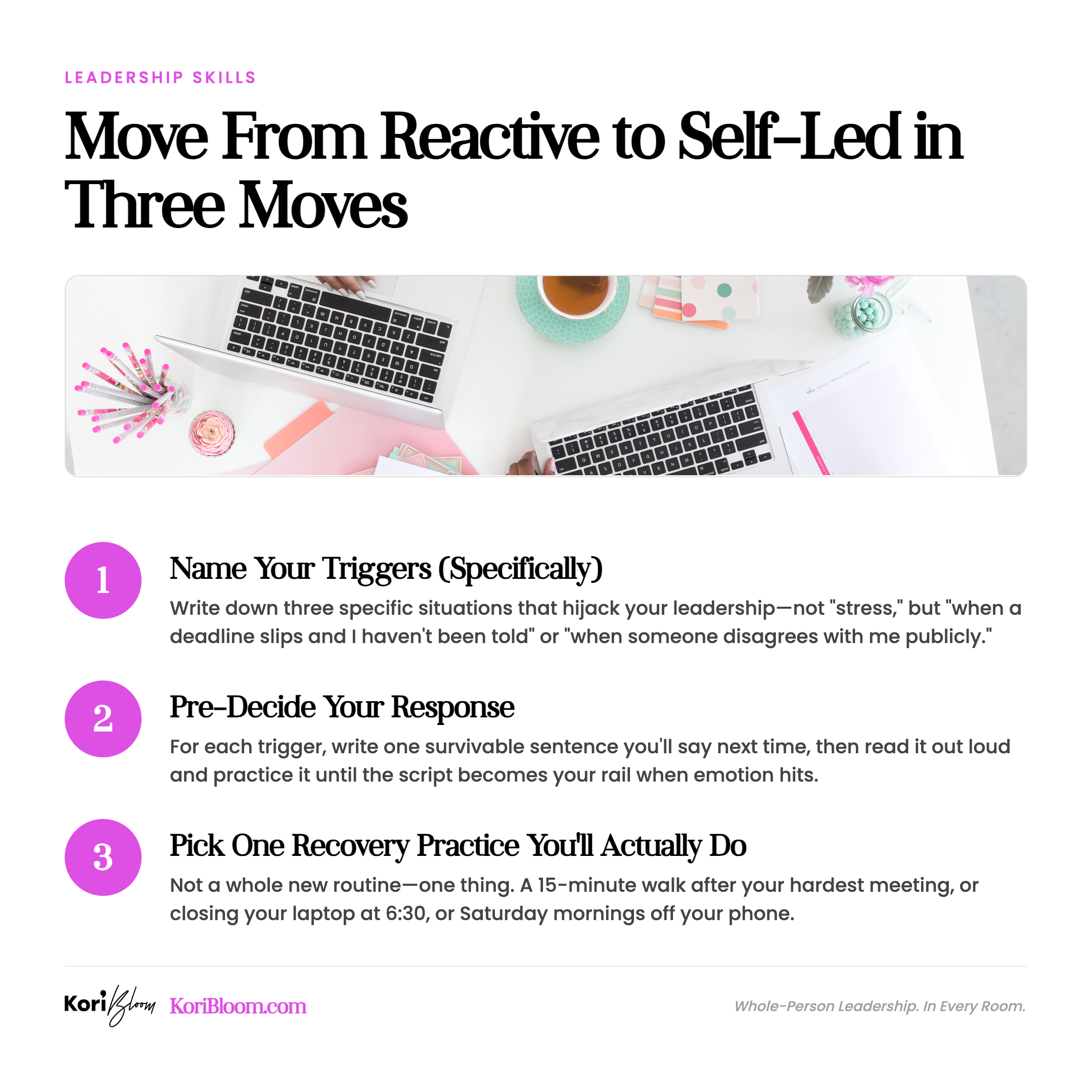
Here's the honest version: you don't fix reactive leadership in a weekend. You build the alternative one repetition at a time. Three places to start this week:
1. Name your top three triggers in writing. Not "stress." Specific. "When a deadline slips and I haven't been told." "When my boss CCs my team." "When someone disagrees with me publicly." You can't manage what you can't name.
2. Pre-decide your response. For each trigger, write the sentence you'll say next time. Not the perfect sentence — the survivable one. Read it out loud. Practice it in the car. The script becomes the rail when the emotion hits.
3. Build one recovery practice you actually keep. Not a new morning routine. One thing. A 15-minute walk after your hardest meeting. Closing your laptop at 6:30. Saturday morning off your phone. Reactive leaders run on empty. Self-leaders refuel on purpose.
One of the first times I remember truly pausing instead of reacting was when I was an educator dealing with a very emotional parent. I remember consciously thinking to myself, "Just listen. Don't formulate a response in your head. Don't take this personally. Just stay present." That moment changed the way I communicated because I realized effective leadership requires us to stop making everything about us. Other people's emotions, frustrations, or reactions are not always personal attacks. To this day, when I feel myself wanting to defend, prove, or "win," I stop, reset, and focus on staying present instead.
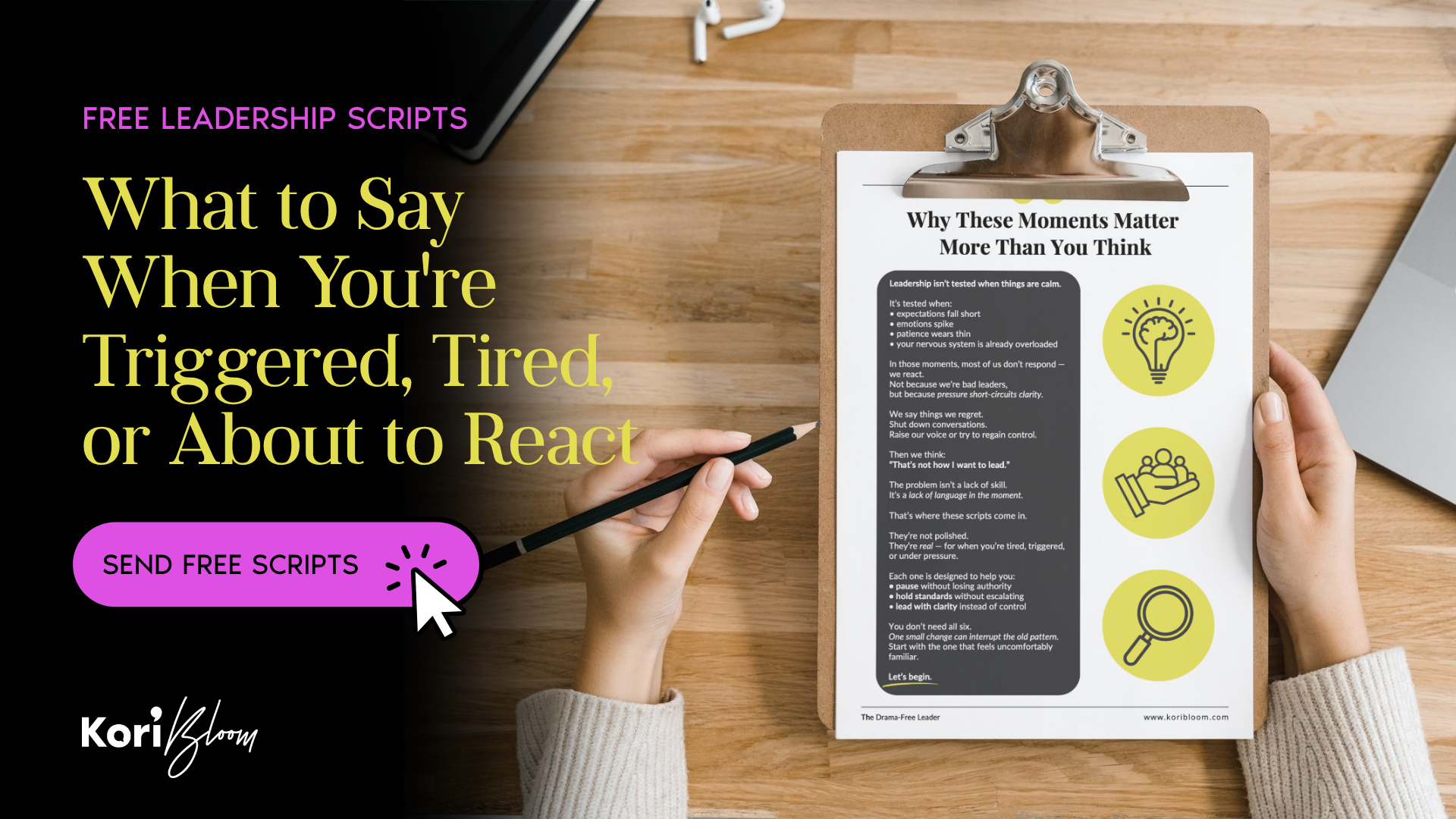
If you want a script library for the moments these tools were built for, that's exactly what The Drama-Free Leader is for — grab the free download here. It's the six scripts our highest-performing clients keep on their desk.
Frequently Asked Questions
What is reactive leadership in simple terms?
Reactive leadership is when your response to pressure is driven by the trigger instead of by your values. It's leading from the part of your brain that's protecting you, instead of the part that's leading other people. The team sees it before you do.
How do I know if I'm a reactive leader?
Ask the people who report to you what they think you'll do before they bring you a problem. If their guess includes any version of "depends on what mood she's in," you've got a reactive pattern. The honest test isn't how you feel about your leadership — it's how predictable you are to your team.
What's the difference between reactive vs. proactive leadership?
A reactive leader skips the pause between trigger and response. A proactive leader builds the pause and uses it to check what they value before they act. Same trigger, different sequence. Same person, different leader.
Can a reactive leader change?
Yes — but not by reading more leadership books. Change comes from naming your triggers, pre-deciding your responses, and building real recovery habits. The shift is built one repetition at a time, usually starting with the moment you don't send the message you wanted to send.
Why is reactive leadership so expensive for a team?
Because it makes high performers leave, makes meetings quieter, makes decisions slower, and pushes hard conversations into the parking lot instead of into the room. Reactive leadership shows up on the P&L through turnover, missed deadlines, and the cost of every decision that has to wait for the leader's mood to settle.
What if my team just won't change?
This is one of the most common mindsets I hear — the belief that "people won't change regardless of what I do." Here's the truth: your team doesn't change because you tell them to. They change because you do. When you shift how you show up, the dynamic shifts with you. Leadership is influence, not enforcement.
Why do I feel like I have to repeat myself constantly as a leader?
Usually one of two things is happening: the expectation wasn't actually clear the first time, or there's no follow-through behind it. Clarity plus consistency beats repetition every time. If you're repeating yourself, it's worth asking which one is missing.
How do I stop taking other people's reactions so personally?
Remember that most reactions aren't about you — they're about what's happening inside the other person. When you stop making their behavior mean something about your worth, you free yourself to respond with curiosity instead of defense. That single shift changes more than any communication script ever will.
What if I'm the one creating the tension on my team without realizing it?
That awareness alone is the start of real change. Most leaders never even ask the question. The fact that you are means you're already further along than you think. The next step is honest feedback — from a coach, a peer, or your team — and the willingness to act on what you hear.
What to Do Next
Reactive leadership isn't a verdict — it's a starting line. The leaders we work with don't become "non-reactive." They become self-led — clearer about what they stand for, faster to recover when they slip, and predictable enough that their team can do their best work without scanning for storms.
If you're ready to lead from values instead of triggers, start with the free guide: The Drama-Free Leader: 6 Scripts to Replace Reactive Communication. It's six pre-decided sentences for the moments your team is already watching for. Download it today and run one of the scripts at your next hard meeting.
Then, if you want to bring this work to your full team, book Kori for your next event — the Lead Yourself First keynote turns this exact framework into a 60–90 minute experience your audience will use the next morning.