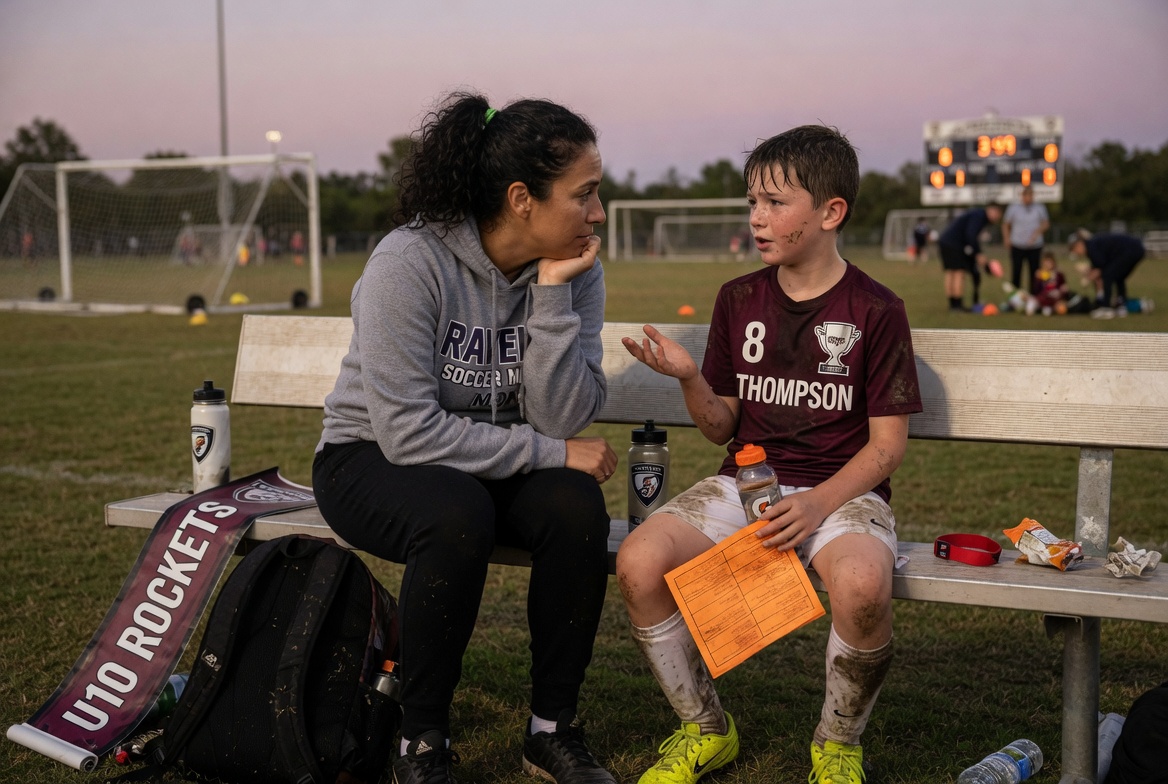
You watched your kid strike out. Or get cut. Or sit the bench while their friend started. And on the drive home, your stomach was in knots because you didn’t know whether to fix it, fight it, or just be quiet and let them feel it.
If you’ve been there, you’re not failing. You’re actually right where the real parenting work begins. Raising resilient kids isn’t about shielding them from disappointment — it’s about teaching them what to do after the disappointment shows up.
In Episode 28 of the Conscious Not Crazy by Kori Podcast, Kori sat down with Emmy-winning sports broadcaster Joel Goldberg to unpack exactly that. Joel has spent decades around elite athletes and the families behind them, and what he’s seen has very little to do with talent — and almost everything to do with identity, relationships, and how kids learn to handle failure. Below are five of the most practical lessons from that conversation, and what they look like in real life at your dinner table this week.
Table of Contents
Why Raising Resilient Kids Starts with the Parent in the Room
Before any of Joel’s tips will stick, there’s one thing worth naming out loud: most of the pressure our kids feel doesn’t come from coaches, teammates, or even social media. It comes from us — usually because we love them and we’re scared for them.
That’s not shame. That’s data.
When we lead from fear (“Did you start? Did you score? Why didn’t you?”), our kids learn that their worth is tied to the scoreboard. When we lead from connection (“What was the hardest part today? What did you learn?”), they learn that their worth is fixed and their performance is just information.
This is the Lead Yourself First shift in action. The conversation we’re capable of having on the car ride home is directly connected to whether we’ve regulated our own disappointment first. Better, not perfect. Every time.
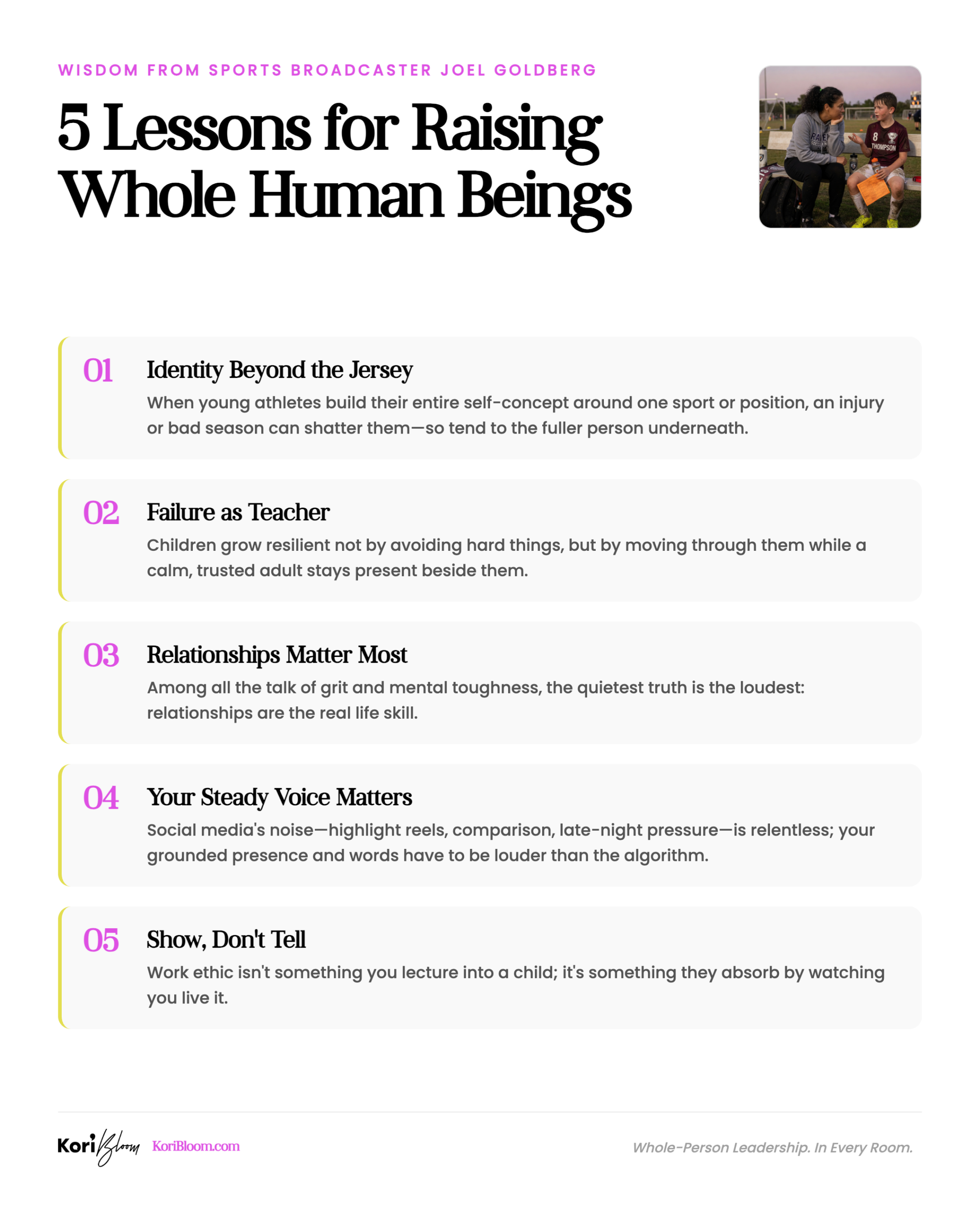
1. Identity Is Bigger Than the Jersey
Joel’s biggest concern with today’s young athletes? They’re building their whole identity on one thing — a sport, a position, a stat line. Then an injury, a cut, or a bad season hits, and the whole self-concept collapses.
A well-rounded identity gives kids more than one place to stand. Joel talks about athletes who succeed long-term because they’re also:
- A good teammate
- A curious student
- A reliable friend
- A kid who shows up for their family
- A human with interests outside the sport
Try this at home: Pick one identity-anchoring question to ask this week. “What’s something you’re proud of today that has nothing to do with the game?” It’s a small script, but it does big work over time.
2. Failure Is the Curriculum, Not the Interruption
Here’s a hard truth from the episode: kids don’t get tougher by avoiding hard things. They get tougher by doing hard things while a trusted adult stays calm next to them.
Joel framed failure not as a bump in the road but as the actual road. Strikeouts. Errors. Hard feedback. Friend drama. Bench time. Those aren’t interruptions to the development plan — they are the development plan.
Our job isn’t to eliminate the failure. Our job is to:
- Resist the urge to rescue.
- Stay regulated when they spiral.
- Ask better questions than we give answers.
- Let the experience teach what our lectures can’t.
This is Conscious Not Crazy in real time — we stay self-aware under pressure so we don’t accidentally take the lesson away from them.
3. Relationships Are the Real Life Skill
For all the talk about grit, work ethic, and mental toughness, Joel kept coming back to one underrated word: relationships.
The athletes who go the distance — and more importantly, the kids who become good adults — are the ones who learned how to:
- Look someone in the eye.
- Handle a hard conversation.
- Show up for a teammate on a bad day.
- Communicate when something is off.
- Repair when they’ve made a mistake.
These are skills, not personality traits. Which means they can be taught. The good news? Your kid is watching you do this every day — at the dinner table, in line at the grocery store, on the phone with a frustrating coworker. They’re learning relationship skills from the way you handle yours.
4. Social Media Is Loud — Your Voice Has to Be Louder
One of the most honest parts of the episode was Joel and Kori talking about the pressure social media puts on today’s kids. Highlight reels, recruiting hype, comparison culture, late-night DMs, anonymous comments — it’s relentless.
You can’t outscroll it. But you can out-relationship it.
Kids who feel deeply known by the adults at home are more inoculated against the noise. Not bulletproof — inoculated. They still see the comparison; they just don’t build their identity on it because someone real is already paying attention.
A few small moves that compound:
- A 10-minute phones-down conversation at bedtime.
- One specific compliment a day that’s about who they are, not what they did.
- Naming the comparison trap out loud so it loses its power.
- Modeling your own healthy boundaries with your phone (this one stings, but it’s true).
5. Work Ethic Is Caught, Not Lectured
Joel made a great point: you don’t have to tell your kid to have a strong work ethic. You have to let them see one.
That doesn’t mean grinding yourself into the ground to set an example. It means letting them watch you:
- Finish what you started, even when you don’t feel like it.
- Show up on time, prepared.
- Take feedback without getting defensive.
- Try, fail, adjust, try again.
- Treat your effort as the part you can always control.
If you want to dig deeper into this, Kori unpacks the whole-person leadership approach to parenting inside the Conscious Not Crazy curriculum — including the scripts that turn these moments into actual conversations instead of lectures kids tune out.
For the broader research on resilience in kids, the Harvard Center on the Developing Child has excellent free resources that line up beautifully with what Joel describes from real-world experience.
The Bottom Line on Raising Resilient Kids
Raising resilient kids is less about the speech you give after a tough loss and more about the steady, regulated, curious presence you bring to the next ten minutes. It’s not about being the perfect parent. It’s about being the present parent.
You don’t have to fix the strikeout. You just have to stay in the dugout with them, ask better questions, and trust that the lesson is already doing its work.
Better, not perfect. That’s the standard.
Listen to the Full Conversation
This blog only scratches the surface. The full 43-minute episode with Joel Goldberg is packed with stories from his decades in sports broadcasting, plus practical scripts you can use this week. Listen to Episode 28 of Conscious Not Crazy by Kori Podcast here.
And if these conversations keep coming up at your house — the reactivity, the hard moments, the “I hear myself saying things I swore I’d never say” — the Conscious Not Crazy 6-Week Course gives you the scripts and frameworks to handle them with composure instead of chaos. It’s the practical toolkit for parents who are ready to stop reacting and start leading.
Frequently Asked Questions
What does raising resilient kids actually mean?
It means teaching kids to handle disappointment, failure, and pressure without losing their sense of self. Resilience isn’t toughness for toughness’s sake — it’s the ability to feel hard things, stay grounded, and keep showing up.
At what age should I start building resilience in my kids?
Right now, whatever age they are. Resilience is built through everyday moments — a frustrating homework problem, a friendship hiccup, a missed shot. The earlier kids see you handle your own stress with composure, the more they absorb it as normal.
How do I help my child after a tough loss or failure without rescuing them?
Lead with presence, not solutions. Try: “That was hard. What part stung the most?” Then listen. Resist the urge to fix, defend, or coach. The lesson is in the discomfort — your job is to keep them company in it, not to remove it.
How does social media affect kids’ resilience?
Social media amplifies comparison and shrinks attention spans for hard feelings. Kids scroll past discomfort instead of sitting with it. The antidote isn’t always a ban — it’s a stronger relationship at home so they have somewhere real to land when the digital noise gets loud.
Where can I learn more about Kori’s approach to conscious parenting?
Start with the Conscious Not Crazy by Kori Podcast for free weekly conversations, or jump into the full 6-Week Conscious Not Crazy Course for the complete framework, scripts, and tools.