
“Mindful parenting” is one of those phrases that’s been used so much it’s almost lost its meaning. For some parents, it conjures meditation cushions and calm voices. For others, it sounds like one more impossible standard to fail. Neither of those is what mindful parenting actually is.
In a recent Conscious Not Crazy episode, I had a powerful conversation with Annmarie Chereso — a conscious relationship coach and international bestselling author who came to this work through her own divorce, pregnancy, and rebuild. What we kept coming back to: mindful parenting isn’t a vibe. It’s a small set of grounded habits that change how you show up. No incense required.
Here are five of those habits — the ones that actually move the needle from fear-based reactivity to authentic, regulated parenting. Better, not perfect.
Table of Contents
Why mindfulness matters in parenting (the unsexy reason)
Mindful parenting isn’t about achieving peace. It’s about noticing what’s happening — in your kid, in the room, and in your own nervous system — before you act. The reason this matters is simple: almost every parenting moment you regret happened because you skipped the noticing step.
Reactive parenting is fast. Mindful parenting is slightly slower. That slight slowness is the entire game.
Habit #1: Name what’s yours before you name what’s theirs
Your kid’s behavior is on the surface. Your reaction to it is a mirror of something inside you — a fear, a memory, a value, a tired body, an old wound. Before you address them, take one second to ask yourself:
“What of this is mine, and what of this is theirs?”
That question is the difference between speaking to the moment and speaking to your own past. It will save you from a lot of conversations you wish you could take back.
Habit #2: Treat your emotions like data, not directives
You will feel frustration. You will feel rage. You will feel disappointment in your kid. None of those are problems. They’re information. They tell you something just got bumped — a value, an expectation, a fear, a fatigue point.
The mindful move is to read the emotion instead of following it. Feelings as indicators, not dictators. You don’t have to act on every wave that comes through. You just have to know it’s a wave.
Habit #3: Repair like it’s a parenting tool, because it is
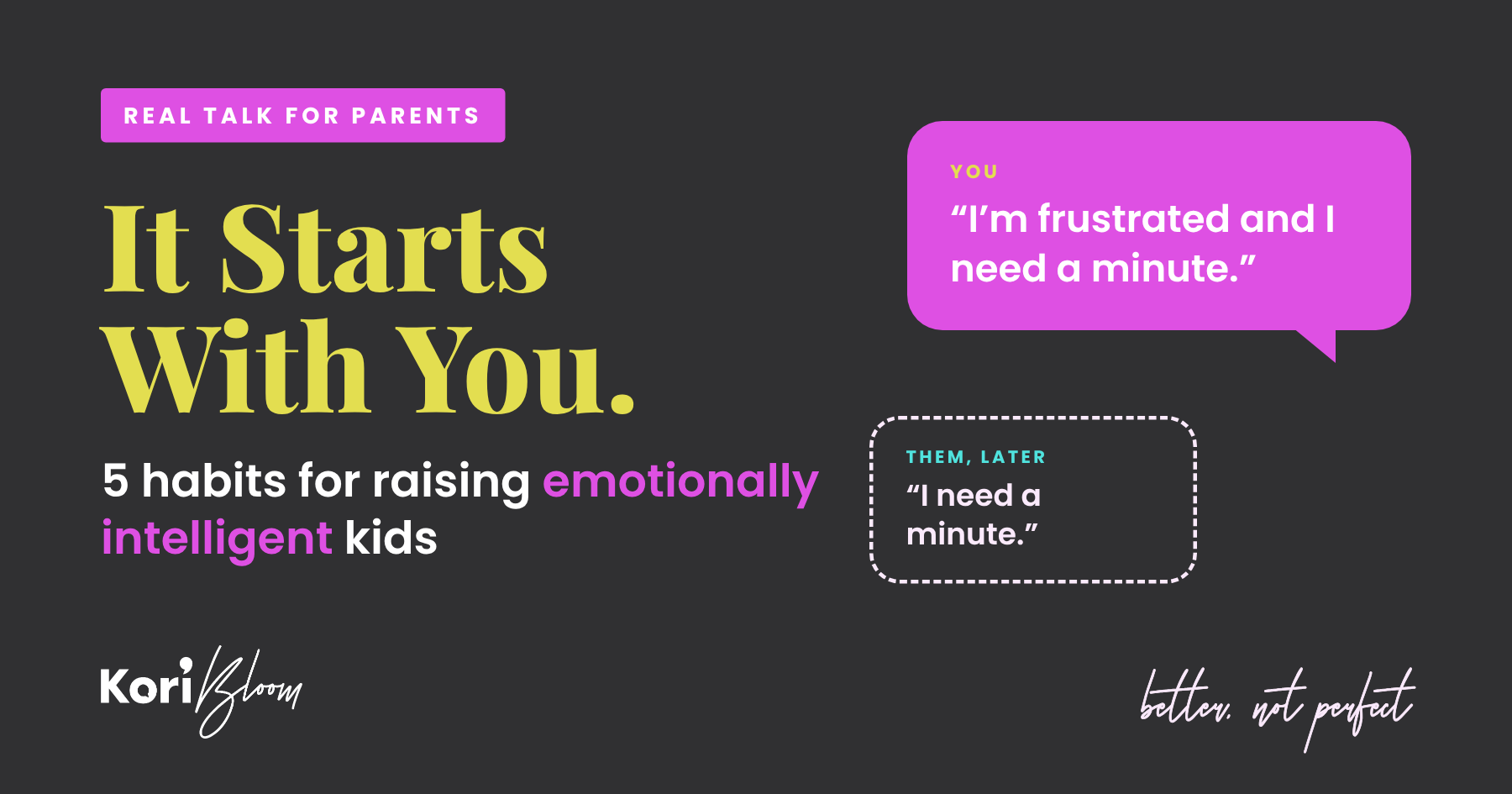
Mindful parents are not parents who never lose it. They’re parents who repair when they do.
“I yelled. That wasn’t about you. I love you. Let’s try again.”
That sentence teaches your kid two things at once: that adults make mistakes too, and that mistakes don’t end the relationship. There is almost nothing more important they can learn under your roof. Repair is not weakness. Repair is leadership.

Habit #4: Move from fear consciousness to love consciousness — in real moments
Annmarie talks about this beautifully: most parenting conflict is happening at the level of fear. Fear they won’t turn out okay. Fear of judgment from other parents. Fear of repeating our own childhood. Fear of being seen as “permissive” or “harsh.”
Love consciousness asks one different question:
“What does this kid need from me right now to feel connected and safe — and how do I do that without abandoning my own integrity?”
Notice it’s not “what does this kid need to feel happy.” Love consciousness still holds the line. It just holds the line from a different place inside you.
Habit #5: Let them experience the consequence of being human
Mindful parents protect their kids from danger. They don’t protect them from disappointment, frustration, or the natural consequences of their own choices. Those are the raw material of resilience.
If you rescue your kid from every hard feeling, you are sending one of two messages: “you can’t handle this,” or “hard feelings are emergencies.” Neither is true. Neither helps. Mindful parenting trusts your kid’s capacity — even when their meltdown suggests otherwise.
Grab the 5 Mindful Parenting Habits
Enter your email and I'll send you the one-page printable — five grounded habits that move you from fear-based reactions to connection that actually lands. Stick it on the fridge. Better, not perfect.
No spam — just the work. Unsubscribe anytime.
You're in.
Your printable is ready — grab it below, then try one habit tonight.
Download the printableThe frame underneath all five: authenticity
Mindful parenting and authentic parenting are the same thing. You can’t do this work by performing calm. The calm has to be real, which means the work has to be real — on you, in you, day after day. That is the work. It is unglamorous and it is the most important leadership project of your life.
Conscious, not crazy. Self-awareness under pressure — not control of every outcome.
Get the scripts for the moments mindfulness needs to land
The CNC Cue Cards are a free, downloadable set of scripts for exactly these high-pressure parenting moments — when you can feel the fear-based response coming and you need the words to choose a different one. Download them at koribloom.com/resources/cue-cards.

If you want the full deep-dive, the Conscious Not Crazy 6-week parenting course walks you through the inner work, the scripts, and the framework for everything in this post. Learn more at koribloom.com/course/conscious-not-crazy.
Listen to the full conversation with Annmarie: Mindful Parenting and Authentic Relationships on the Conscious Not Crazy podcast.
About Kori Bloom
Kori Bloom is a keynote speaker, author of The Business of Parenting, and creator of the Conscious Not Crazy parenting course. She helps growth-minded leaders and parents communicate with composure, alignment, and intention — in every room. Learn more at koribloom.com.