

You know the moment. You’re mid-sentence in a meeting and someone cuts you off. Upper management drops a “quick pivot” on you at 4:47 on a Friday. You hand off a project and it comes back nothing like what you asked for — again. Your face gets hot. Your jaw locks. And the version of you that shows up next isn’t the leader you actually want to be.
Most leadership advice tells you to “manage your emotions” or “just breathe.” Fine in theory — except your brain is already three steps ahead, drafting the reply you’ll regret by Friday. What you actually need in that moment isn’t a feeling. It’s a sentence. One line you can say out loud that buys back your composure and signals to the room that you’re still leading.
I learned that the hard way on a day when everything was on fire. We were short-staffed and pivoting constantly just to keep things moving, and a coworker started spiraling — naming every possible problem that might happen later. I could feel myself getting pulled right in. Instead of reacting, I paused and asked, “Is there a problem we need to solve right now?” She said no… and kept right on listing future what-ifs. So I asked again: “Outside of what we’ve already handled today, is there anything that actually needs to be addressed right now?” Again — no.
That moment stuck with me, and it’s something I teach constantly now: when we stay locked on future problems, we burn time and energy spinning in fear instead of solving. Self-leadership is staying present, focusing on what’s right in front of you, and handling the solutions you can actually reach in the moment.
That’s what scripts are for. They’re not corporate-speak and they’re not fake. They’re the bridge between the trigger and the response — the thing you grab onto so you can lead yourself first instead of reacting and cleaning it up later.
Below are five scripts for the moments that tend to set leaders off. Pick the one that hits closest to home. Practice it out loud. Use it next time it fits. Better, not perfect.
Remember, when you're triggered at work what to say can make all the difference in maintaining your leadership presence.
Table of Contents
Why getting triggered at work is a leadership problem (not a personality problem)
Getting triggered isn’t a flaw. It’s a signal — it means something just hit a value, a fear, or a pattern that matters to you. The problem isn’t the trigger. It’s what happens in the seven seconds after it.
In those seven seconds, most of us do one of three things. We react (snap, shut down, fire off the email). We avoid (go quiet, leave the room, ghost the thread). Or we perform (overexplain, smooth it over, and seethe later). None of those build trust. None of them move the work forward. And every one of them chips away at your credibility over time.
Self-leadership is the choice you make in those seven seconds. A script gives you something to hold onto so that choice gets easier — at work, and honestly, at home too.
Script #1: When you face public criticism or pushback in a meeting
The trigger: You’re in a meeting and a peer or leader takes a shot at your work — publicly. It might be fair. It might not be. Either way, every set of eyes just landed on you.
What most leaders do: They either launch into a defensive justification (“Well, actually, the reason we did it that way is…”) or go flat with “Okay, I’ll look into it,” which reads as dismissive or shrinking. Neither one serves you.
The script: “That’s worth slowing down on. Can you walk me through what you’re seeing so I can address it specifically?”
Why it works: You’re not agreeing and you’re not arguing. You’re putting the burden of specificity back on the speaker, which turns a vibe-based critique into a real conversation. It also tells the room you can take feedback in real time without flinching — one of the fastest credibility moves there is.

Script #2: When you feel like you have to micromanage because no one does it “right”
The trigger: You hand something off and it comes back wrong — again. Now you want to take it all back, redo it yourself, and hover over every step next time. The story in your head: “If I want it done right, I have to do it myself.”
What most leaders do: They quietly redo the work (resentment and burnout build) or nitpick every detail (the team stops trying). Both teach your people to bring you less and lean on you more.
The script: “Here’s exactly what ‘done right’ looks like to me, and here’s the one piece I need you to own. What do you need from me to get there?”
Why it works: Micromanaging is usually a control response to a quiet fear that someone else’s work will reflect on you. This script trades control for clarity. It names the standard out loud — so it stops being a guessing game — and hands ownership back to your person. You’re leading the work without doing the work. People rise to a clear bar and shrink under a moving one.

Script #3: When you’re repeating yourself for the third (or thirtieth) time
The trigger: You said it in the meeting. You said it in the email. You said it in the 1:1. And someone just asked you the exact thing you already answered. You can feel the “like I said…” rising in your throat.
What most leaders do: They sigh and repeat it (“As I mentioned…”), which quietly shames the other person, or they give up and just do it themselves — right back to micromanaging. Neither one fixes why the message isn’t sticking.
The script: “I’ve explained this a few times and it’s still not landing, which tells me I haven’t made it clear enough yet. Let’s find the gap — what’s getting in the way of this sticking?”
Why it works: This is self-leadership in real time. Instead of making the other person wrong for not getting it, you take ownership of the communication and turn the moment into problem-solving. Sometimes the real gap is a broken process, an unclear priority, or a tool that doesn’t work — things repeating yourself will never fix. You’ll only find that out if you ask.

Want the full set?
The Drama-Free Leader: 6 Scripts to Replace Reactive Communication is a free PDF I built for the leaders I work with. It includes every script in this post — plus one more I only share inside it — formatted so you can keep it on your desk or screenshot it to your phone. Grab it at koribloom.com/drama-free-leader.
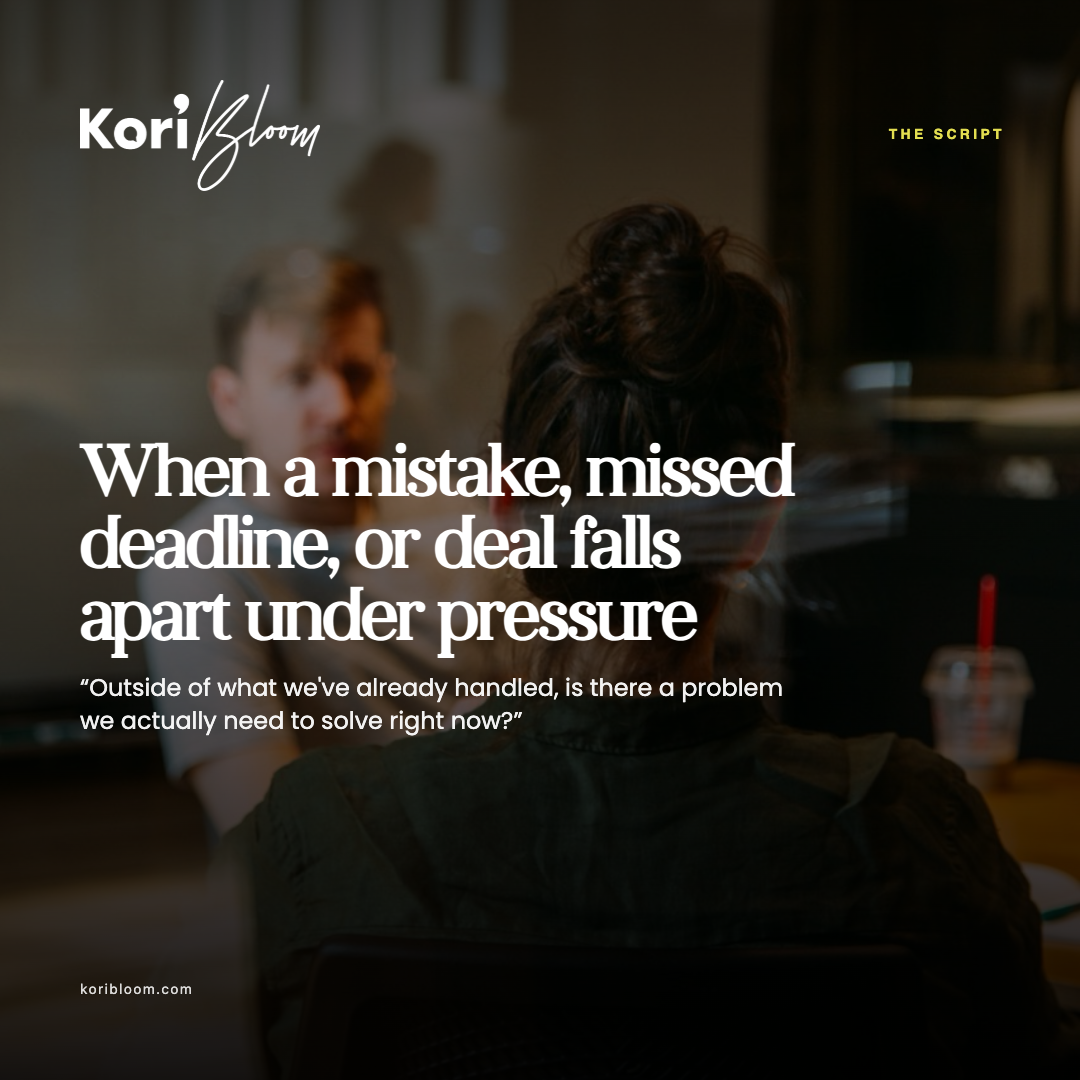
Script #4: When a mistake, missed deadline, or deal falls apart under pressure
The trigger: Something just broke. A deadline blew up, a deal you were counting on died, or a real mistake surfaced at the worst possible time. The pressure spikes — and suddenly everyone (maybe including you) starts spiraling into every other thing that could go wrong next.
What most leaders do: They react to the fear instead of the facts: assign blame, catastrophize the next ten dominoes, or go silent and try to absorb all of it alone.
The script: “Outside of what we’ve already handled, is there a problem we actually need to solve right now?”
Why it works: Remember that short-staffed day from the top of this post? This is the question that came out of it. When the pressure’s on, most of the energy in the room flows toward future problems that haven’t happened yet. That spinning feels productive, but it’s just fear wearing a deadline’s clothes. This line pulls everyone back to what’s actually in front of you — the one thing you can handle now. You solve that, then the next. Staying present is the most underrated leadership skill there is.
Script #5: When upper management hands you tense feedback or unrealistic pressure
The trigger: Your VP delivers sharp feedback, or drops a target or timeline that simply isn’t realistic — and the unspoken expectation is that you’ll absorb it and make it work. Your weekend, your team’s plan, your stress level: all of it just shifted.
What most leaders do: They say “No problem, I’ll make it happen,” then go quiet, do the work resentfully, and pass the pressure straight down to their team. Or they get defensive and shut the conversation down before it starts.
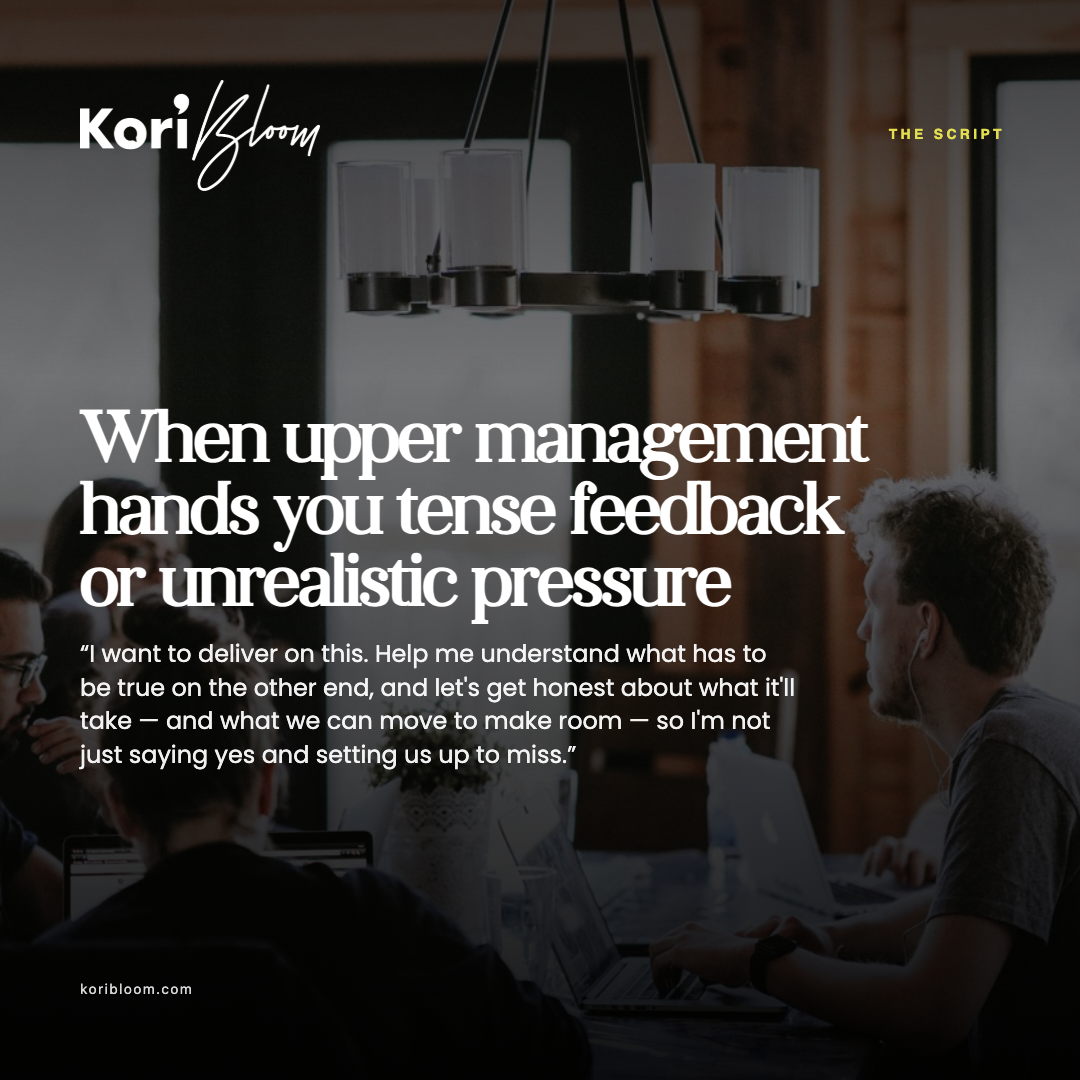
The script: “I want to deliver on this. Help me understand what has to be true on the other end, and let’s get honest about what it’ll take — and what we can move to make room — so I’m not just saying yes and setting us up to miss.”
Why it works: You’re not pushing back and you’re not rolling over — you’re stepping up. You’re refusing to absorb unrealistic pressure quietly, and instead modeling the conversation that protects both the outcome and your people. Leadership respects the leader who can manage up with composure instead of fear. And your team doesn’t end up inheriting a panic that started two levels above them.
“Kori gives great insight and tips to help people think about how they respond to the environment around them and react to life differently.”
Kim, The Pinnacle Society
Keep these 5 scripts handy
Want all five of these in one place? Download the free Triggered at Work Script Card (PDF) — print it, pin it, or save it to your phone so the right words are there the second you need them.
Keep these 5 scripts handy
Want all five of these in one place? Enter your email and I’ll send you the free Triggered at Work Script Card — print it, pin it, or save it to your phone so the right words are there the second you need them.
No spam, ever. Just the good stuff — unsubscribe anytime.