

Most people draw a hard line between how they lead at work and how they parent at home. Different rooms, different versions of you, different rules. But the longer I’ve coached leaders and the longer I’ve raised humans, the more I’ve come to believe that line isn’t real. It’s drawn in pencil — and the second you erase it, your life gets a lot less exhausting.
This is the heart of what I call whole-person leadership. The skills that make you a steady, respected leader at work are the same skills that make you a calm, connected parent at home. Not similar. The same.
If you’ve ever caught yourself thinking, “I’m a totally different person at the office than I am at dinner,” you’re not broken. You’re just leading two rooms with two different scripts when one set of skills could carry you through both.
Table of Contents
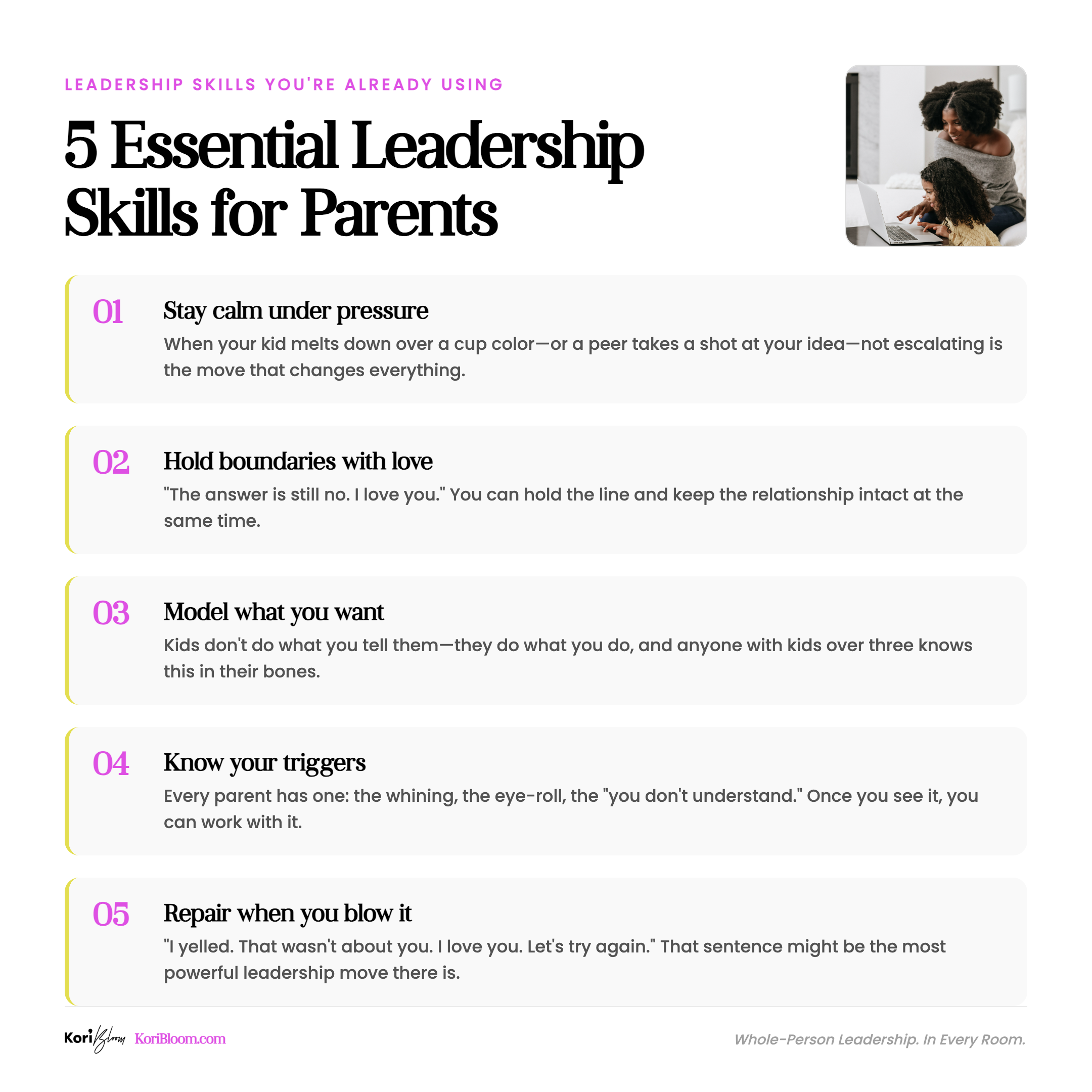
5 Essential Leadership Skills for Parents
Here are five leadership skills you’re already using as a parent — most of them without realizing it — and how to bring them more intentionally into both rooms.
Why the Parent-CEO Connection matters (and why most leaders miss it)
In the Conscious Not Crazy podcast episode this post is based on, I unpack what I call The Business of Parenting — the realization that the foundational skills of running a team and the foundational skills of raising a family are nearly identical. Emotional intelligence. Setting boundaries. Naming your triggers. Modeling the behavior you want to see. Owning failure without collapsing.
Most leadership development programs teach those skills like they’re corporate competencies. They’re not. They’re human skills. Which means if you’re practicing them at 6 a.m. with a kid who lost their other shoe, you’re practicing them at 6 p.m. in a status meeting too — whether you’ve noticed or not.
This is why I tell HR leaders and event planners that the leaders in their organization are walking around with untapped capacity. The reps they’re putting in at home are real. They just haven’t been named, framed, or transferred. Let’s name them.
Skill #1: Emotional intelligence under pressure
At home, this is the moment your kid has a meltdown over the wrong color cup and you choose not to escalate. At work, it’s the moment a peer takes a shot at your idea in front of the team and you don’t snap back.
Same skill. Same nervous system. Different room.
Emotional intelligence isn’t about being unflappable — it’s about noticing you’ve been flapped, naming what just got hit, and choosing your next move on purpose. That’s leadership work. And if you’ve survived a single Tuesday with toddlers, you have more reps in it than most executives.
The version of you that doesn’t yell at the dinner table is the same version of you that doesn’t fire off the reactive email. Train the one, and the other gets stronger by default.
The version of you that doesn’t yell at the dinner table is the same version of you that doesn’t fire off the reactive email. Train the one, and the other gets stronger by default.
Skill #2: Setting boundaries without burning the relationship
Parents do this constantly. “The answer is still no. I love you. The answer is still no.” You hold the line and the love at the same time.
That same skill at work sounds like: “I can’t commit to that timeline. Here’s what I can commit to.” Or: “I’m not the right approver on this. Here’s who is.” Or simply: “Let me get back to you Monday — I need to think about it first.”
Boundaries aren’t walls. They’re leadership tools. They tell people what to expect from you, which is the most generous thing you can do for the people you work with and the people you live with.
Skill #3: Modeling the behavior you actually want to see
Kids don’t do what you tell them. They do what you do. Anyone with children over the age of three knows this in their bones.
Your team is the same. If you preach work-life balance and then send Slack messages at 11 p.m., they’re reading the messages, not the speech. If you talk about psychological safety and then snap when someone disagrees with you, they’re tracking the snap.
The good news: you don’t have to be perfect. You have to be congruent. Better, not perfect. The leader who says “I lost my cool in that meeting, that’s on me, here’s what I’ll do differently” teaches more about leadership in 30 seconds than a quarterly all-hands ever could.
Skill #4: Knowing your triggers — and what they’re really about
Every parent has a trigger they didn’t see coming. For some it’s the whining. For some it’s the eye-roll. For some it’s the “you don’t understand” from a teenager.
Every leader has triggers too. Public pushback. Being interrupted. Last-minute scope changes from leadership. A colleague taking credit. The body knows them — heart rate up, jaw locked, voice tight — long before the brain catches up.
The work isn’t to eliminate triggers. It’s to map them. This is the heart of my Trigger-to-Response Map — knowing your reactive pattern well enough that you can choose a different response before the old one runs. Parents practice this every day. Leaders can too.
Skill #5: Owning failure without collapsing into shame
Good parents repair after they blow it. “I yelled. That wasn’t about you. I love you. Let’s try again.” That sentence is one of the most powerful leadership moves on the planet — and most of us learned it at home.
Bring the same skill into the office. “That decision didn’t land the way I hoped. Here’s what I missed. Here’s what I’m doing differently.” No collapse. No spiral. No 45-minute apology that’s really about your discomfort. Just clean ownership and a forward move.
This is the leadership behavior that builds trust faster than any other single thing — and parents are getting reps in it three times a day.
Bringing it together: lead yourself first, in every room
When I tell leaders “lead yourself first,” what I mean is exactly this: the version of you that shows up at the dinner table and the version of you that shows up at the executive table aren’t two people. They’re one nervous system, one set of values, one practice. When you stop trying to be a different leader in each room, two things happen. You stop being exhausted by the switch — and you start being respected for the consistency.
That’s the Parent-CEO connection. Not a metaphor. A practice.
Get the leadership scripts I use with corporate audiences
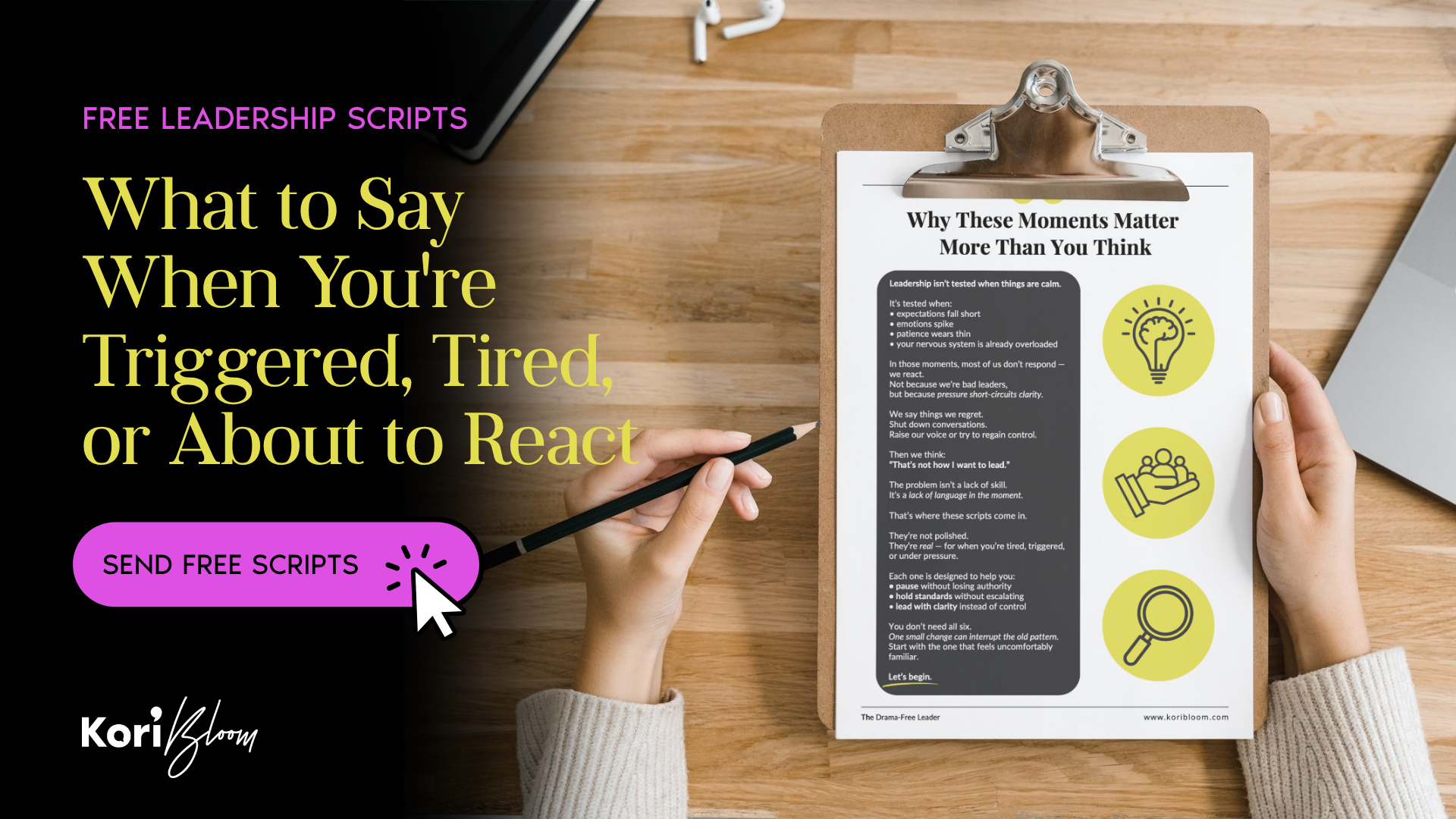
The Drama-Free Leader: 6 Scripts to Replace Reactive Communication is the free PDF I built for the leaders I work with. It includes the exact language to use in the moments where most leaders react — public criticism, last-minute pivots, hard feedback, credit-taking colleagues. Download it free at koribloom.com/resources/drama-free-leader.
If you’re an HR or event leader looking for a keynote that bridges leadership at work and leadership at home — the kind that gives your people tools they can use the same week — explore Whole-Person Leadership at https://koribloom.com/speaking/ or send me a note at hello@koribloom.com.
Want the longer version of this conversation? Listen to The Business of Parenting: The Parent-CEO Connection on the Conscious Not Crazy podcast.
About Kori Bloom
Kori Bloom is a keynote speaker, author of The Business of Parenting, and creator of the Conscious Not Crazy parenting course. She helps growth-minded leaders and parents communicate with composure, alignment, and intention — in every room. Learn more at koribloom.com.