
Your kid slams a door. Or refuses to eat the dinner they asked for. Or has a complete meltdown in the cereal aisle. And in that moment, every cell in your body wants to deal with the surface — the door, the food, the volume, the scene. Stop the behavior. End the scene. Move on with your life.
But here’s the thing every conscious parent eventually learns the hard way: the behavior isn’t the story. The behavior is the tip of the iceberg. And if you keep parenting the tip, you’ll be parenting the tip forever.
This is what I call the iceberg lens — and it’s one of the most useful tools I share with parents in workshops, in the Conscious Not Crazy course, and in the podcast episode this post is based on. Once you see it, you can’t unsee it. And once you start using it, parenting gets a lot less reactive.
Table of Contents
The iceberg analogy of behavior, in plain English
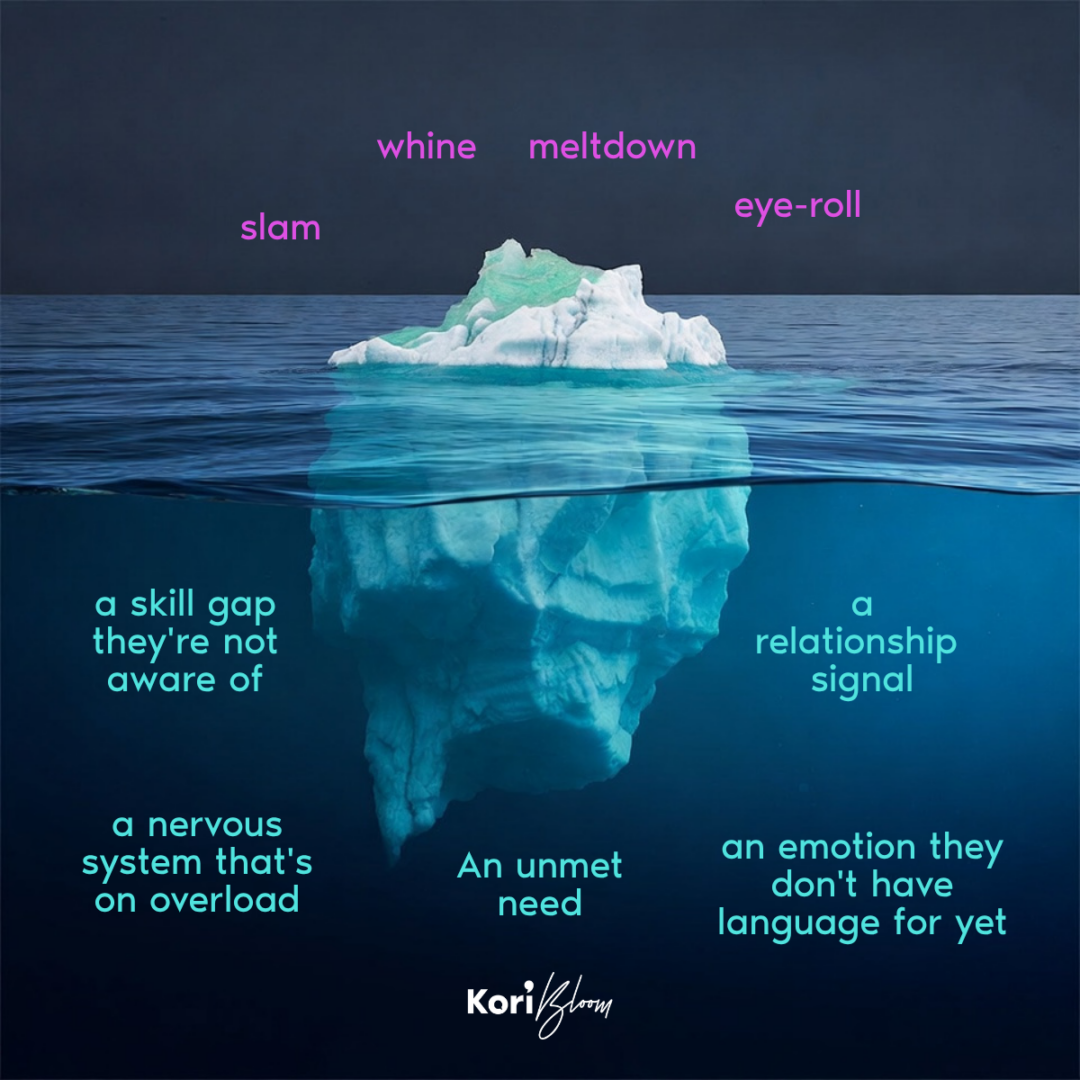
What is an example of an iceberg analogy? Picture an iceberg. The tip — the part you can see — is maybe ten percent of the total mass. The other ninety percent is underwater, hidden, doing all the actual work of holding the iceberg up.
Your kid’s behavior works the same way. What you see — the slam, the whine, the meltdown, the eye-roll — is the visible tip. Underneath, hidden from view, is everything driving it:
- An unmet need (tired, hungry, overstimulated, lonely)
- An emotion they don’t have language for yet (overwhelmed, embarrassed, disappointed)
- A skill gap they’re not aware of (can’t regulate, can’t transition, can’t lose gracefully)
- A nervous system that’s on overload (sensory, social, schedule)
- A relationship signal (“I need to know you still love me when I’m hard”)
Reactive parents fight the tip. Conscious parents look under the water.
Why this changes everything
When you treat the tip as the whole story, your scripts get short and sharp: Stop. Knock it off. We don’t do that in this house. Sometimes those work. Often they don’t — because the behavior isn’t what’s actually driving the moment.
When you remember the iceberg, your scripts get curious: What just shifted? What did they need 60 seconds before the door slammed? What didn’t I see? Curiosity buys you time. Time buys you a real response. A real response builds trust. Trust builds the kind of relationship where, ten years from now, your kid still picks up the phone.
Better, not perfect. You won’t get this right every time. The goal is to look under the water more often than you used to.
How to actually use the iceberg lens in real time
Frameworks are easy to nod at and hard to remember at 6:47 p.m. Here are three moves you can use the next time a behavior shows up at your house.
Move 1: Pause and ask the iceberg question — silently, to yourself
“What’s underneath this?”
Don’t ask your kid yet. Ask yourself. You’re not solving the behavior — you’re looking for the driver. Tired? Hungry? Embarrassed? Overstimulated? Disappointed? Has something hard been happening at school? Did the last 20 minutes contain three transitions in a row?
Most of the time, the answer comes faster than you’d expect. Your nervous system already has a guess. Listen to it.
Move 2: Name what you see, not what you want
“Something’s really hard right now. I’m here.”
That’s the sentence. It does not fix the behavior. It does not excuse the behavior. It tells your kid two things they desperately need to hear: I see you, and I’m not leaving. From that ground, the behavior almost always shifts faster than it would have if you’d gone after the tip.
Move 3: Address the underwater part later
Heat-of-the-moment is not the time for the big conversation. Your kid’s nervous system is not online. Neither is yours.
Come back to it when everyone is calm — in the car, at bedtime, the next morning. That’s when you say: “I noticed something hard happened earlier. I’m curious what was going on for you.” That’s when the underwater part gets named, owned, and worked on. That’s when the actual parenting happens.
Get the free Iceberg Lens cheat sheet
The behavior isn't the story — it's the tip. Drop your email and I'll send you the one-page Iceberg Lens cheat sheet: the silent question to ask yourself and the exact scripts to use when the meltdown is still moving.
No spam, ever. Unsubscribe anytime. — Kori
You're in.
Your Iceberg Lens cheat sheet is ready — grab it below and keep it where you'll see it.
Download the Cheat SheetThe hardest part: your own iceberg
Here’s the move most parenting advice skips: your kid’s iceberg isn’t the only one in the room. Yours is too.
When your kid’s behavior triggers you, something underwater in you just got hit. Maybe a fear about how they’re going to turn out. Maybe a pattern from your own childhood. Maybe a value that just got bumped (“we don’t talk to each other like that”). Maybe you’re running on three hours of sleep and a granola bar.
Self-awareness isn’t bonus parenting. It is parenting. You can’t respond to your kid’s iceberg if you’re completely run by your own. This is the heart of conscious, not crazy — self-awareness under pressure, not control of every outcome.
So the practice is two icebergs at once. Look under their water. Look under yours. Choose your next move from there.
Get the scripts for the moments under the surface
The CNC Cue Cards are a free, downloadable set of scripts for exactly these moments — the meltdowns, the power struggles, the bedtime stalls, the “I hate you” doorways. They’re built to use under pressure, when the iceberg is still moving. Download them at koribloom.com/resources/cue-cards.
And if you want the full deep-dive — the Conscious Not Crazy 6-week parenting course walks you through the iceberg lens, the Trigger-to-Response Map, and a complete set of communication tools for the moments that matter most at home. Learn more at koribloom.com/course/conscious-not-crazy.
Want the longer version? Listen to the full Transformative Parenting episode on the Conscious Not Crazy podcast.

About Kori Bloom
Kori Bloom Lauritsen is a keynote speaker, author of The Business of Parenting, and creator of the Conscious Not Crazy parenting course. She helps growth-minded parents communicate with composure, alignment, and intention — in every room. Learn more at koribloom.com.