
"I do everything for you! How could you do this to me?"
Yep. I said it. Out loud, to my own kid. And the second it left my mouth, I wished I could take it back.
Have you ever said something, then stopped and thought, Wait a minute. Where did that come from?
Maybe it sounded like something you heard growing up. Maybe it was a reaction you swore you'd never have. I know I've been there, and I think most of us have.
Why? Because so much of what we say and do comes from patterns we picked up long before we even realized it. It's our autopilot.
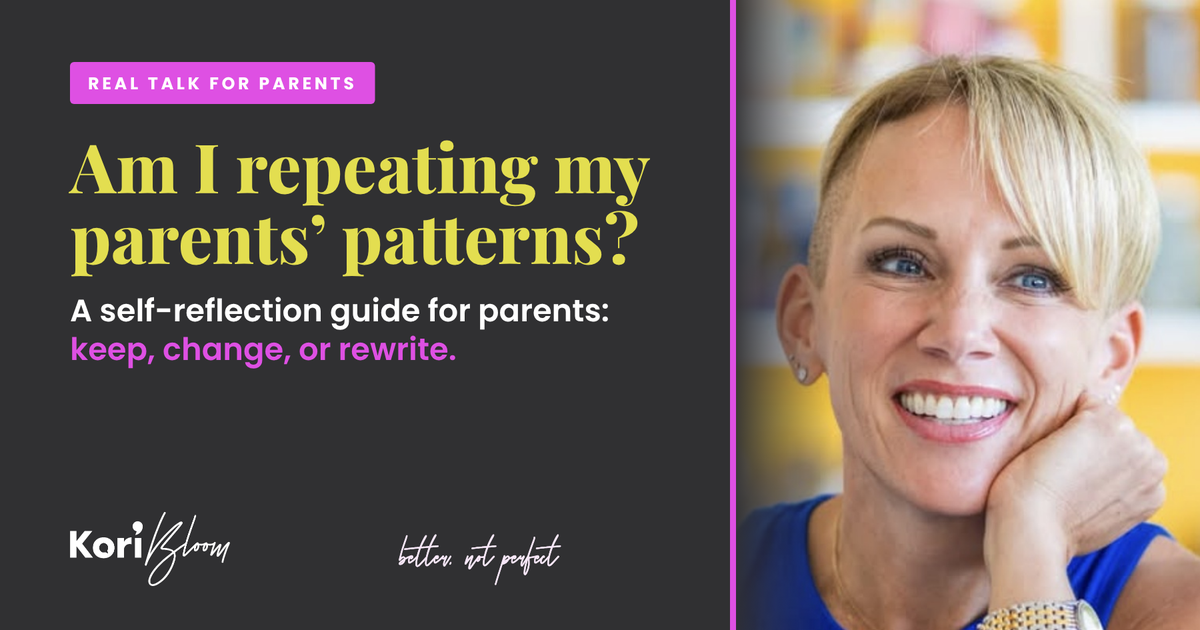
And that's the question behind this post: Am I repeating my parents' patterns?
Here's the answer. Probably, yes. Some of them, anyway. We all picked up many of our reactions before we were old enough to choose them. That's not a character flaw. It's being human.
The good news? Just because you learned a pattern doesn't mean you have to repeat it.
Noticing your parents' patterns is the first step toward deciding which ones you want to keep and which ones you want to change.
This guide gives you self-reflection questions, a simple Keep / Change / Rewrite exercise, and a few scripts for those moments when you catch yourself falling back into old habits.
One important note before we start: This is a mirror, not a verdict. It's about understanding yourself, not judging the people who raised you.
Table of Contents
The Words That Come Out of Your Mouth (Before You Can Stop Them)
"I do everything for you" wasn't my only greatest hit. There was also "You're making me crazy!" And the classic, "I told you so! Maybe you'll listen next time."
Every time, the same thing happened afterward. Shame. Regret. Then I'd beat myself up for the mistake, which never made the next moment go any better.
What changed things for me wasn't trying harder to be perfect. It was learning three things: Better, Not Perfect™, the pause, and repair. A mistake doesn't have to be the end of the story. You can own it, repair it, and begin again.
So if you're reading this because you heard an old voice come out of your mouth this week, welcome. You're in good company, and you're not broken. You're paying attention, and that's where change starts.
Why Your Parents' Patterns Show Up Under Pressure
Patterns live on autopilot. They were wired in early, through thousands of small moments you watched and absorbed long before you could think about them. You don't decide to use them. They just run.
That's why they show up most when you're stretched thin. In my experience, the biggest triggers aren't dramatic. They're ordinary:
- Messes (so many messes)
- Running late
- Financial stress, or feeling like you have no control
- Too much on your plate
- Stress at work or with your partner
- Sleep deprivation (the big one)
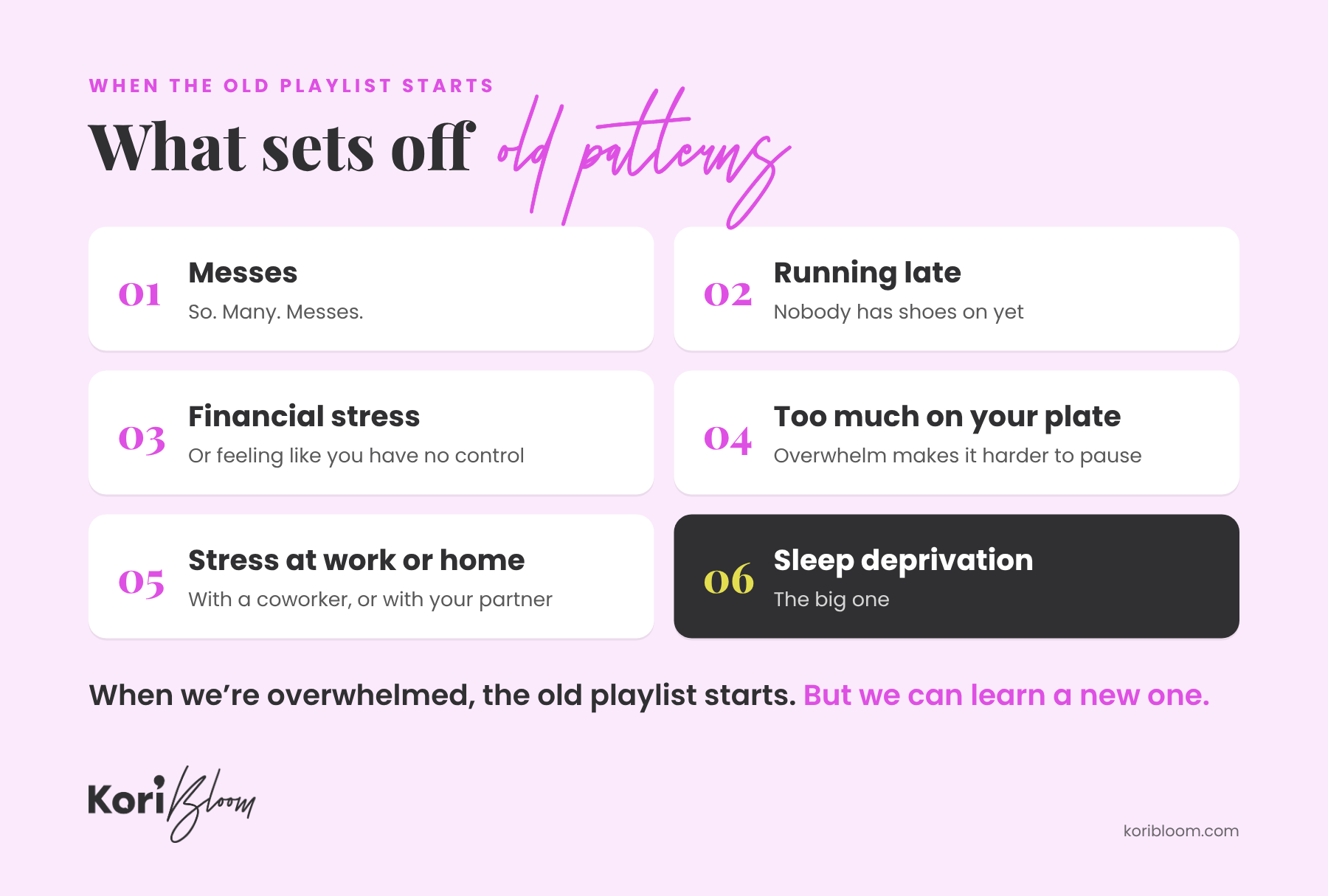
When we're overwhelmed, it becomes harder to pause, think clearly, and choose our response. That's when the old playlist starts playing.
But here's the good news: We can learn a new playlist.
Research on child development reminds us that our experiences don't have to define our future. Harvard's Center on the Developing Child explains how supportive relationships and learned skills build resilience over time.
The patterns we were handed don't have to be the ones we pass on.
The pattern I see most often in parents
When I work with parents, the most common inherited pattern isn't yelling or the silent treatment. It's trying to make or control a child's behavior instead of trying to understand it.
Right behind it: worrying about what our child's behavior says about us. Are people judging me? Do they think I can't handle my own kid? When we get focused on how our children look to others, we lose sight of what they're actually trying to tell us. (More on that in the iceberg under your kid's behavior.)
Value or Pattern? How to Tell What You Actually Believe
Here's the simplest way I know to sort it out:
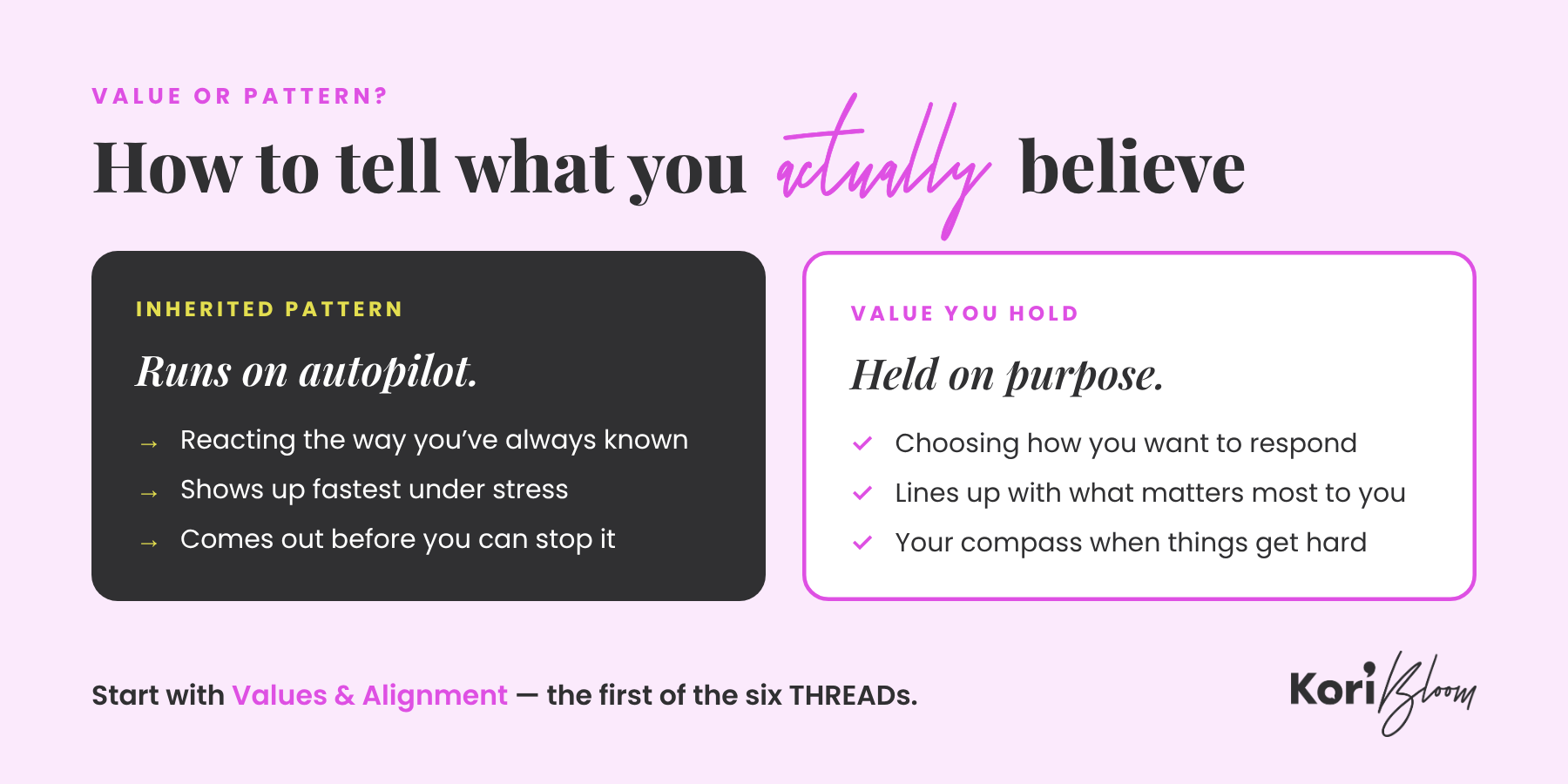
Patterns run on autopilot. Values are held on purpose.
A pattern is reacting a certain way because it's what you've always known. A value is choosing how you respond because it lines up with what matters most to you.
That's why, of all six of my THREADs, the one I start with here is Values & Alignment. Honestly, all six threads play a role. But anything meaningful needs a strong foundation, and you have to know what you value before you can move forward with intention. Your values are your compass.
What I Kept, and What I Changed
Not every pattern needs to go. Some of the best things in my parenting were handed to me.
My dad bought a business when I was in high school, and working in that business taught me lessons I still carry today. Hard work. Accountability. Kindness. Humility.
But one of the most valuable lessons my dad taught me was that selling isn't about convincing someone to buy something. It's about connecting with people, asking questions, and uncovering what they really need so they can make the right decision.
Understand first. Sell second.
That lesson has stayed with me far beyond the business world.
He also taught me that you can care about people while still holding them accountable. My dad didn't rescue me from the consequences of my choices, and looking back, that was a gift. Those lessons shaped how I lead and how I parent.
But there were also patterns I wanted to change.
Throughout my childhood, I witnessed a fair amount of conflict as I navigated my parents' multiple marriages and divorces. As a kid, that can create uncertainty, especially when you're trying to make sense of adult situations you don't fully understand.
Looking back, those experiences have shaped how I approach parenting today. I know how uncertainty can feel, and I know how much I value connection and communication. That's why I make it a priority to talk openly with my kids, especially when life gets messy.
Adult problems may affect our kids, but that doesn't mean they're responsible for them.
I want my kids to feel loved and secure, knowing that even when life gets complicated, they don't have to carry the weight of adult problems.
When I went through my own divorce, I wanted my kids to understand that it wasn't their fault, that they were loved by both of us, and that some things are simply for adults to work through.
I've also been intentional about how I speak about their dad. Kids should feel free to love both parents without feeling caught in the middle. Relationships can be complicated, but I never want my kids to feel like they have to choose sides.
The point isn't that my parents got everything wrong or that I'm getting everything right. Far from it.
It's about recognizing what I want to carry forward and what I want to do differently.
That's what parenting with intention looks like. Not perfection. Awareness, choice, and a willingness to grow.
Watch Out for the Over-Correction
Breaking a pattern can swing you too far the other way. Me? I probably do too much for my kids. I know it. Better, Not Perfect. It's a daily balancing act between when to step in, when to support, and when to step back and let them figure it out.
10 Self-Reflection Questions for Parents
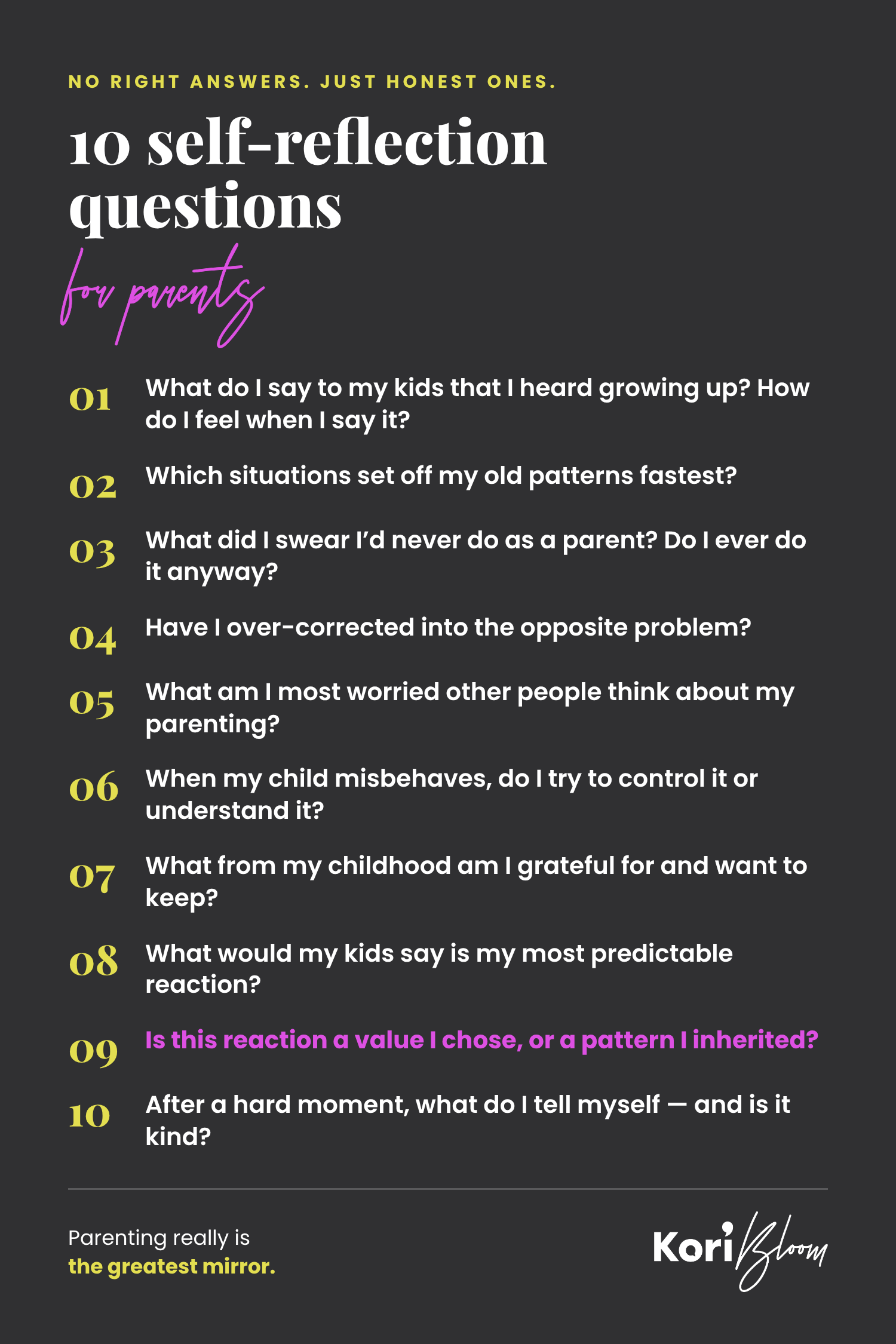
Grab a notebook, or just think through these on your next drive. No right answers. Just honest ones.
- What's something I say to my kids that I heard growing up? How do I feel when I say it?
- Which situations set off my old patterns fastest (messes, running late, money, back talk)?
- What did I swear I'd never do as a parent? Do I ever do it anyway?
- What did I swear I'd never do, and have I over-corrected into the opposite problem?
- What am I most worried other people think about my parenting?
- When my child misbehaves, is my first move to control it or to understand it?
- What's one thing from my childhood I'm genuinely grateful for and want to keep?
- What would my kids say is my most predictable reaction?
- Is this reaction a value I chose, or a pattern I inherited?
- After a hard moment, what do I tell myself, and is it kind?
Some of these might surprise you. One I didn't fully see for years was people-pleasing: how much time and energy I spent worrying about what others thought of me. I started noticing it during some hard seasons in my marriage, when my kids were little and I was still growing into being a parent. Parenting really is the greatest mirror.
The Keep / Change / Rewrite Exercise
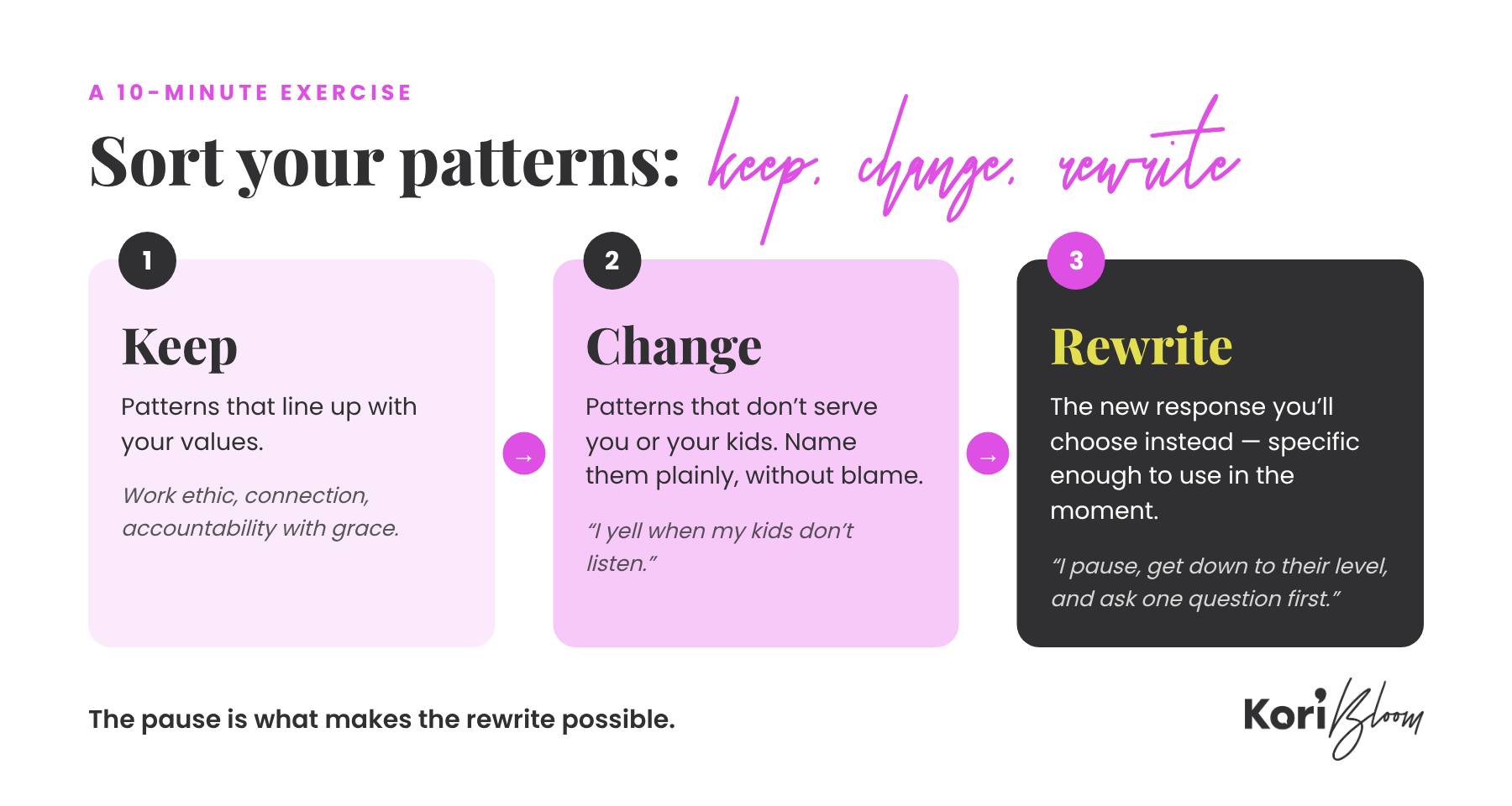
Once you've noticed a few of your parents' patterns, sort them. This takes about ten minutes.
- Keep: Patterns that line up with your values. (For me: work ethic, connection, and accountability with grace.)
- Change: Patterns that don't serve you or your kids. Name them plainly, without blame.
- Rewrite: For each "Change," write the new response you want to choose instead. Make it specific enough to use in the moment.
For example: Change: "I yell when my kids don't listen." Rewrite: "When they don't listen, I pause, get down to their level, and ask one question before I say anything else."
That rewrite is where my Trigger-to-Response Map comes in. The pause interrupts the inherited pattern and gives you the time to flip your script. Instead of repeating the story you've always known, you ask a better question: What would make it most likely they choose well here? If you want the full walkthrough, start with how to stop reactive parenting.
Scripts for the Moment You Catch Yourself Repeating Your Parents' Patterns
A script for you, in the moment
Ask yourself two questions:
"Is that true?" "Is that helpful?"
Is what I'm thinking actually true right now? Is that thought helping me move forward? If the answer is no, come back to the present. Get curious. Ask questions. Gather more information. Then move forward with intention.
A script for repair with your child
"I didn't handle that well. I was triggered, and I'm sorry. I love you. Let's try that again."
Repair teaches your kids that everyone makes mistakes, and that mistakes don't define us. New habits take practice, and there's no perfect. Mistakes are just information and a chance to learn, repair, and begin again. (Need more words for hard moments? Here are 7 scripts for parenting without yelling.)
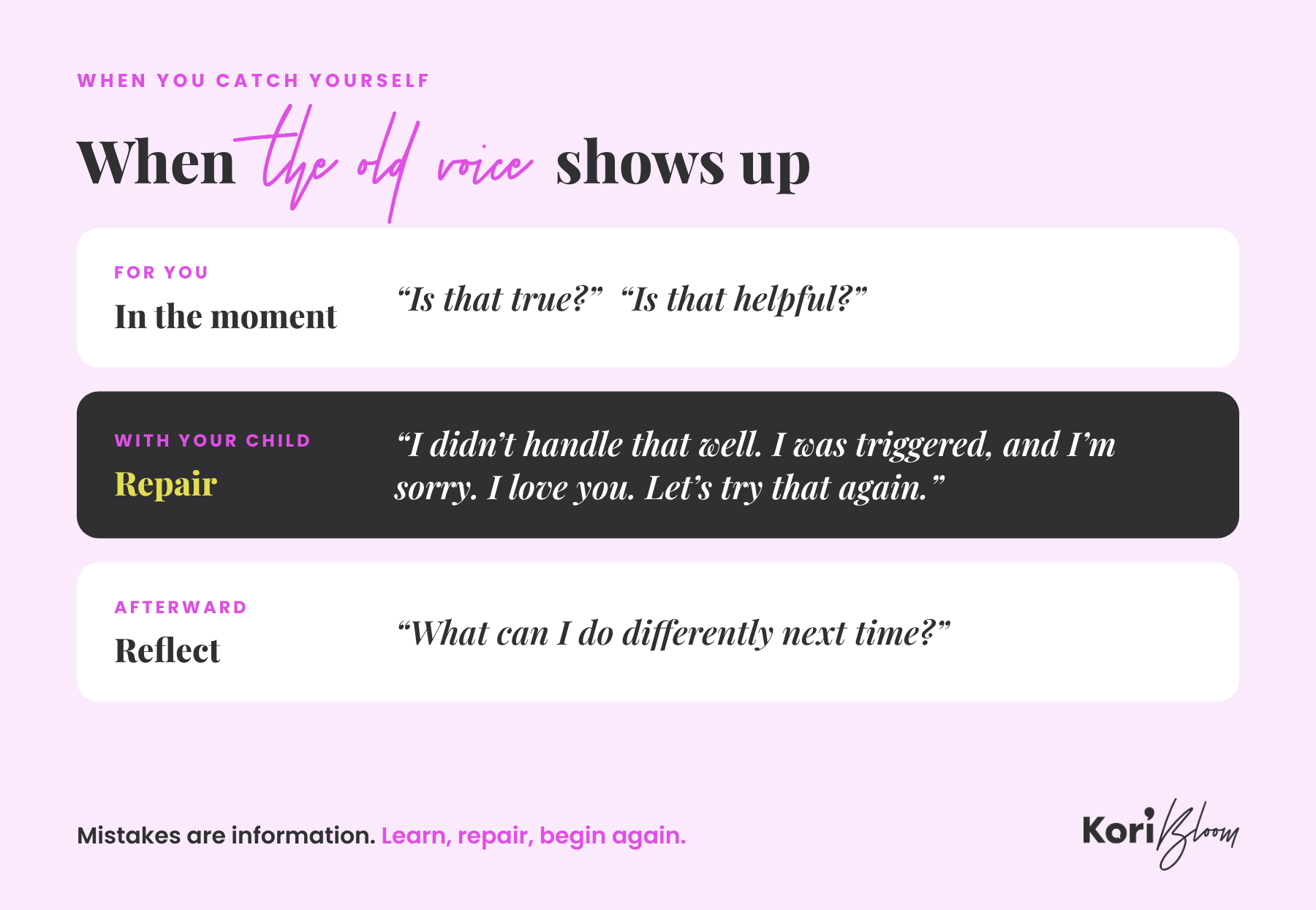
A script for after
After a reactive moment, here's what I ask myself: What can I do differently next time? And then I remind myself: I did the best I could with the tools I had in that moment, and I'm gaining more tools every day.
Breaking Generational Patterns Without Blaming Your Parents
This is the part where a lot of people get stuck. Asking these questions can feel disloyal, like you're criticizing the people who raised you.
Here's how I hold it. I believe my parents did the best they knew how with the toolbox they had. They loved me. I thank God for my experiences, because they brought me to where I am today. I choose gratitude. And I know many people have faced far harder circumstances than mine.
"We can't change the past. But we can choose how we move forward."
Holding both truths at once
"My parents did the best they could" and "I want to do it differently" can both be true. Here's how to hold them together:
- Feel it. Acknowledge your feelings instead of dismissing or minimizing them.
- Own it. You are the author of your story. You can begin again whenever you choose.
- Separate explain from excuse. Our experiences may help explain our reactions, but they don't excuse unhealthy behavior.
What Not to Do After Reading This
Please don't take this list to Thanksgiving dinner!
The goal isn't to assign blame. It's to better understand ourselves, recognize the patterns, and choose what we want to carry forward. Holding on to blame can keep us stuck. Growth happens when we focus on what we can change.
Personally, I lean on my faith and trust God's plan.
Boundaries, on the other hand, matter a lot. You can't control other people's behavior, but you can decide what you need for a healthy relationship, what you'll allow, and what you won't.
When to get support
If you feel stuck and can't seem to move forward, please reach out to a licensed therapist or counselor. I'm especially drawn to approaches that recognize the mind-body connection and help change unhealthy thought patterns and the stories we keep telling ourselves. It's like an unhealthy playlist on repeat. Good support helps you process and heal instead of staying stuck in rumination.
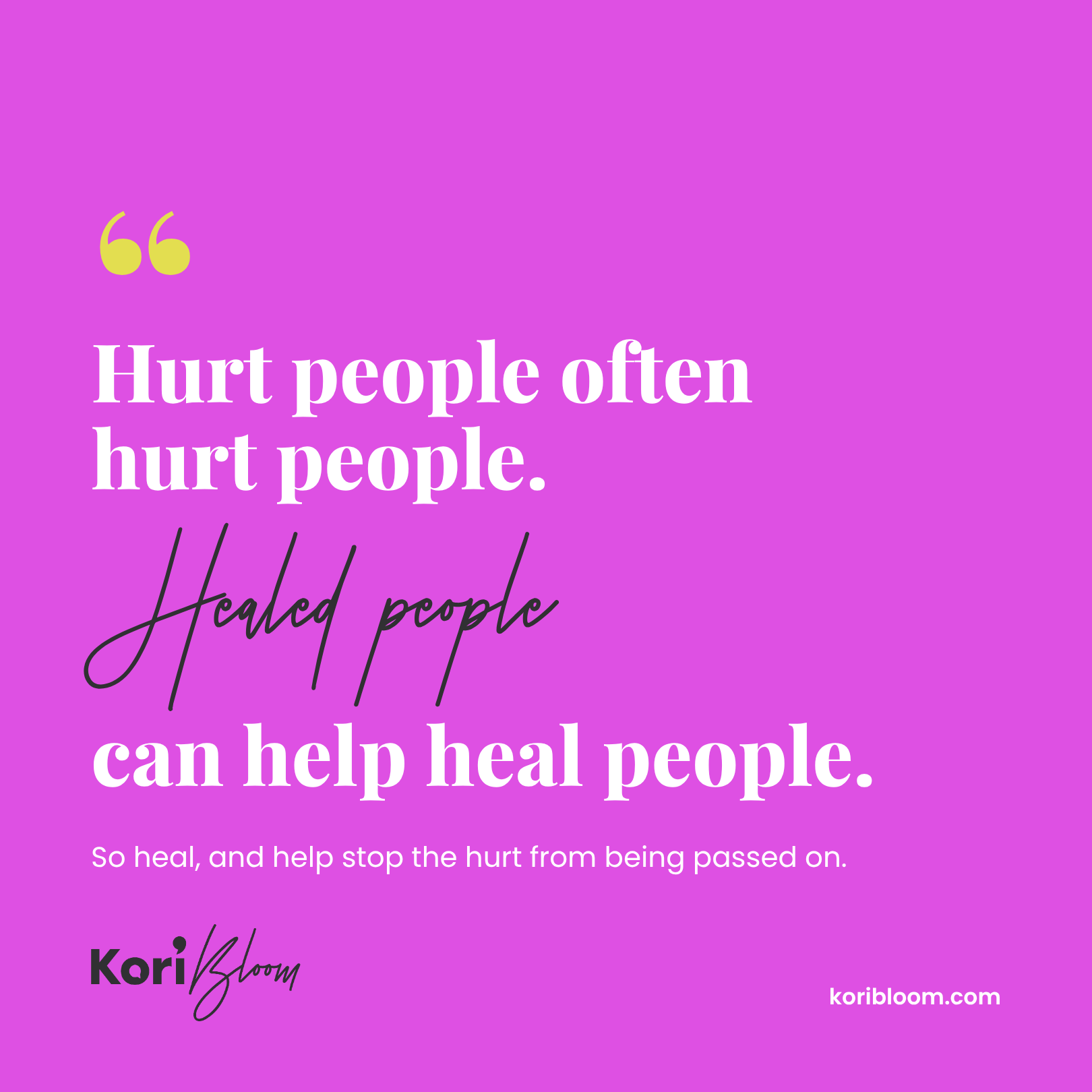
Hurt people often hurt people. Healed people can help heal people.
Sometimes the person we most need to understand, care for, and heal is ourselves. So heal, and help stop the hurt from being passed on.
Why This Matters Even If You Don't Have Kids
If you were ever a child, this applies to you. We were all shaped by our childhood and life experiences, and those experiences shape how we think, communicate, react, and connect.
It shows up at work, too. What triggers you with a coworker usually isn't that different from what triggers you at home. We might show more self-control at work because our job is on the line, or because we care what people think. At home, where we feel safe, the old reactions slip out more easily.
That's why I believe in leading yourself first, no matter the room. Leadership isn't situational. How we show up matters everywhere.
What Changes When You Choose Differently
The payoff is connection. When you do this work, you create an environment where your kids feel more comfortable talking to you. They can share their struggles knowing you'll love and support them, even when they mess up.
And here's what I want you to walk away with: you were never meant to be perfect. Embrace being a flawed human. We all are. You're not alone, and every mistake is another chance to begin again with more tools and more awareness.
- What you do matters more than anything you say.
- Connection comes before correction.
- Live curious, not furious.
- Shame doesn't serve anyone, not you and not your child.
You can't control another person, including your kids. Fear-based control damages the very connection you're trying to build. Healthy boundaries work better, because they build critical thinking, responsibility, and motivation that comes from within. The goal is kids who make good choices because they understand why those choices matter, not because they're afraid.
Your One Thing This Week: Pause
If you only do one thing after reading this, make it this: pause.
Put a little space between the trigger and your response, so you can respond on purpose instead of reacting on autopilot.
Turn off autopilot and take the wheel.
You can't rewrite your childhood, but you can choose what you carry forward.
And sometimes, that choice begins with something as simple as a pause.
Better, Not Perfect™. One moment, one choice, one opportunity to grow.
Want help in the moment? Download my free CNC Cue Cards, a set of scripts for the pressure moments when old patterns try to take over. And if you're ready to go deeper, the Conscious Not Crazy parenting course walks you through all six THREADs, starting with your values.
For more on this topic, listen to the Conscious Not Crazy podcast episodes "Building a Conscious, Not Crazy Parenting Toolbox" and "Raising Emotionally Intelligent Children." You can also read the parenting toolbox post and 5 habits for raising emotionally intelligent kids.
Frequently Asked Questions
How do I know if I'm repeating my parents' patterns?
Listen for the moments when a phrase or tone comes out before you've chosen it, especially under stress. If you hear yourself saying something you swore you'd never say, or reacting the same way every time a certain trigger hits, that's usually an inherited pattern running on autopilot.
Is it disloyal to question how I was raised?
No. Reflecting on your parents' patterns isn't the same as blaming them. Most parents did the best they could with the tools they had. You can be grateful for what they gave you and still choose to do some things differently.
What is the first step in breaking generational patterns?
Pause. Create space between the trigger and your response so you can notice the old pattern and choose a new one. Then sort what you notice into Keep, Change, and Rewrite.
What should I say to my child after I react in a way I regret?
Keep it simple and own it: "I didn't handle that well. I was triggered, and I'm sorry. I love you. Let's try that again." Repair shows your child that mistakes don't define us.
When should I get professional help?
If you feel stuck, can't move forward, or the same hurt keeps replaying, a licensed therapist or counselor can help you process it and heal. Needing support is a strength, not a failure.
About Kori Bloom
Kori Bloom is a keynote speaker, author of The Business of Parenting, and creator of the Conscious Not Crazy parenting course. She helps growth-minded leaders and parents communicate with composure, alignment, and intention, in every room. Learn more at koribloom.com.