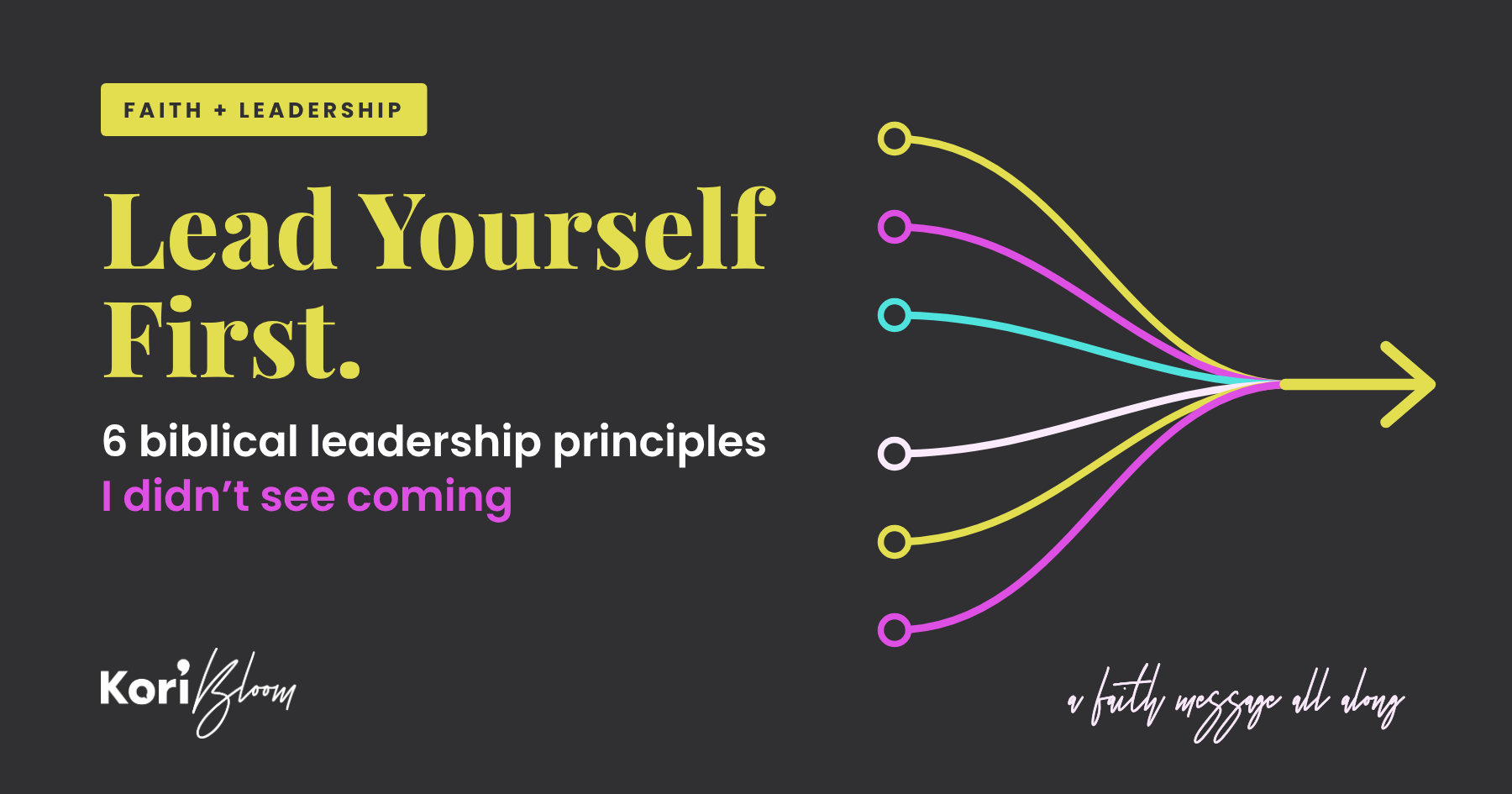

Some of the most practical biblical leadership principles aren't hidden in a theology textbook. They show up in the moments you're tired, triggered, and deciding who you're going to be next. For years, I've taught six threads of Whole-Person Leadership to parents, educators, and business teams. What I didn't see coming was where those threads had been pointing all along.
The six threads of Whole-Person Leadership didn't appear overnight.
They have evolved over years of teaching parents, working with educators, leading in business, raising my own kids, and honestly, just living life.
Values & Alignment. Mindset. Attention. Communication. Action. Growth & Resilience.
Over time, I have gotten more and more clarity around these six threads and how they connect.
But recently, I started wondering:
What if the clarity wasn't simply mine?
Table of Contents
When I Realized My Six Threads of Leadership Were Biblical
As I have grown in my faith and spent more time reading Scripture, I have begun seeing these six threads everywhere.
And that realization stopped me.
Because maybe I wasn't creating something new at all.
Maybe, as I have grown closer to God, I have simply become more aware of truths that were already there. The principles I teach. The ideas I try to live. The lessons I share with parents, educators, and leaders.
They continually point me back to Scripture.
And honestly, it makes perfect sense. If I am walking more intentionally in my faith, it would make sense that greater clarity would bring my work into greater alignment with God.
So I started looking more closely at the overlap. And it is pretty amazing.
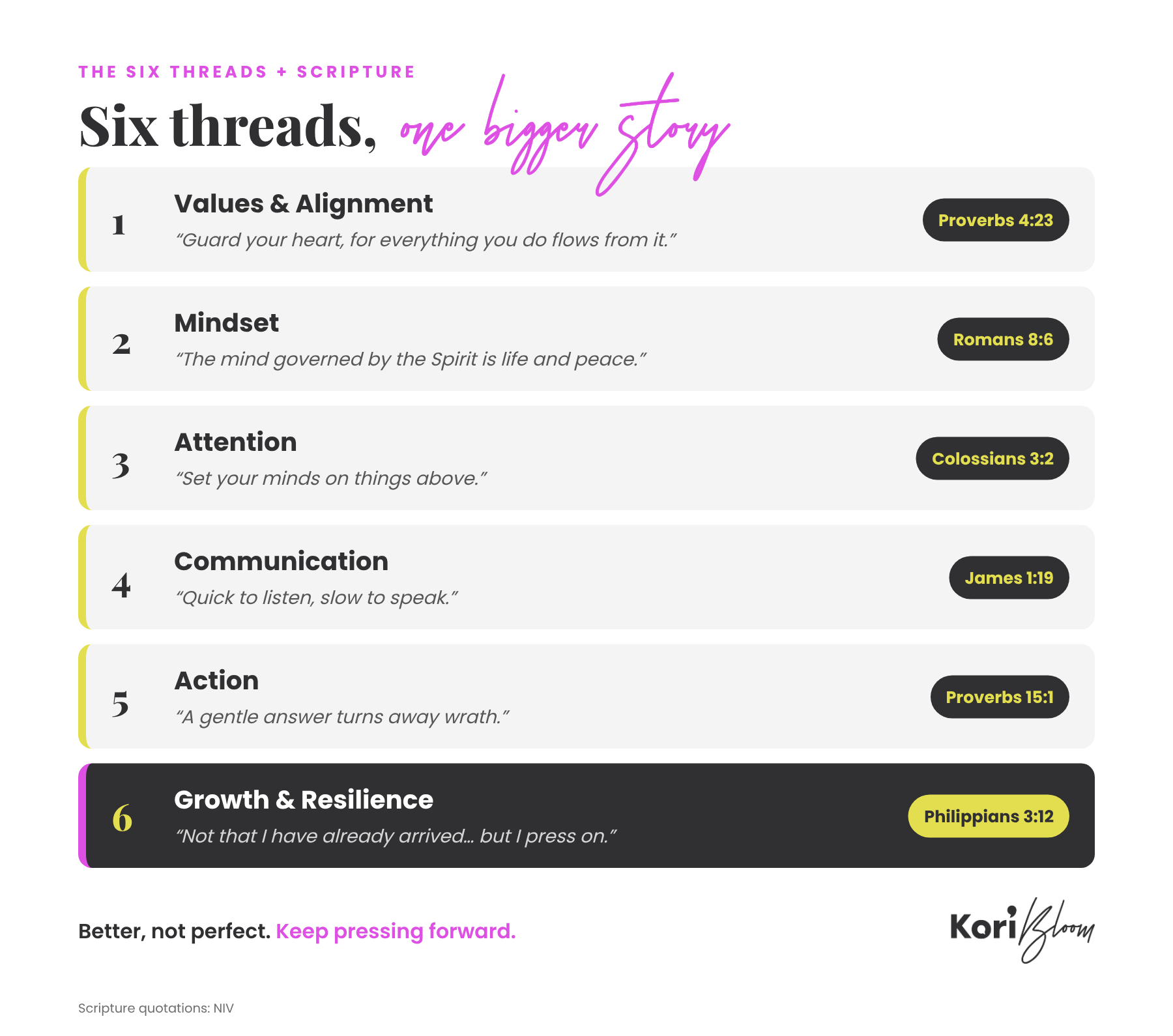
6 Biblical Leadership Principles Woven Into Whole-Person Leadership
1. Values & Alignment ❤️
I start almost every parenting course, educator workshop, and business keynote in the same place:
What do you value?
And maybe more importantly: Are you actually living in alignment with those values?
Because knowing what matters to you is one thing. Living like it matters is another.
As leaders, we model our values for the people around us. At home, our children learn far more from what we live than what we say. In organizations, values might show up in a mission statement, but the real question is whether those values can be seen in the everyday behavior of the people who lead.
Scripture asks an even bigger alignment question.
Galatians 1:10 asks whether we are trying to please people or please God, reminding us that if our primary goal is gaining the approval of others, we cannot fully live as servants of Christ.
That is alignment. Who am I trying to please? What is actually guiding my decisions?
Proverbs 4:23 tells us:
"Above all else, guard your heart, for everything you do flows from it."
What we continually allow into our hearts shapes what flows out of our lives.
So guard what matters. Know what you value. And ask yourself whether the way you are living actually reflects it.
Leadership question: What is guiding me?
2. Mindset 🧠
One of the principles I talk about often is: Assume the best.
Not because everyone will always do the right thing. Not because difficult situations aren't real. And not because we should ignore problems.
But because the story we tell ourselves about another person often determines how we respond to them.
Scripture repeatedly reminds us to pay attention to our thoughts. Philippians 4:8 tells us to think about what is true, noble, right, pure, lovely, admirable, excellent, and praiseworthy.
Romans 8:6 tells us:
"The mind governed by the Spirit is life and peace."
God continually calls us to renew our minds and be intentional about where our thoughts live.
That is mindset. Assume the best. Look for the good. Choose possibility over fear.
Mindset isn't pretending everything is good. It is refusing to let negativity become your default lens.
Leadership question: What am I allowing to shape my thinking?
3. Attention 👀
I say this all the time: Attention is your most valuable currency.
Because where your attention goes, your energy usually follows.
What we focus on grows. What we repeatedly notice begins shaping how we see our lives, our relationships, our work, and ourselves.
Colossians 3:2 says:
"Set your minds on things above, not on earthly things."
Again, there it is. Intentional attention.
We live in a world competing constantly for our focus. Phones. Notifications. Comparison. Fear. Busyness. Other people's opinions.
If we aren't intentional about where we place our attention, something else will gladly choose for us.
Attention fuels growth. Distraction creates drift.
Leadership question: What has my attention today?
4. Communication 🗣️
One of my foundational leadership beliefs is: Connection before correction.
Whether I am talking about parenting, teaching, marriage, or managing a team, people are far more receptive when they first feel heard.
James 1:19 says:
"Everyone should be quick to listen, slow to speak and slow to become angry."
Listen first. Understand first. Connect first. Then respond.
I often say: Be curious, not furious. Ask instead of assume.
Listening isn't simply waiting for your turn to speak. It is creating enough space for another person to feel seen and understood.
That changes conversations. And relationships.
Leadership question: Am I listening to understand?
5. Action 👣
Leadership eventually requires action. But not every action needs to be immediate.
One of the most practical tools I teach is learning to create space between what happens to us and what we do next.
The trigger happens. The temperature changes. Emotion rises.
And we have a choice: react automatically or respond intentionally.
Proverbs 15:1 tells us:
"A gentle answer turns away wrath, but a harsh word stirs up anger."
Wisdom often requires enough space to choose our response. Your triggers do not have to determine your next move. (If you want words for that moment, start with these 5 scripts to use when you're triggered at work.)
Your greatest strength as a leader isn't controlling everyone around you. It is learning to lead yourself.
Pause long enough to let your values, rather than your emotions, determine what happens next.
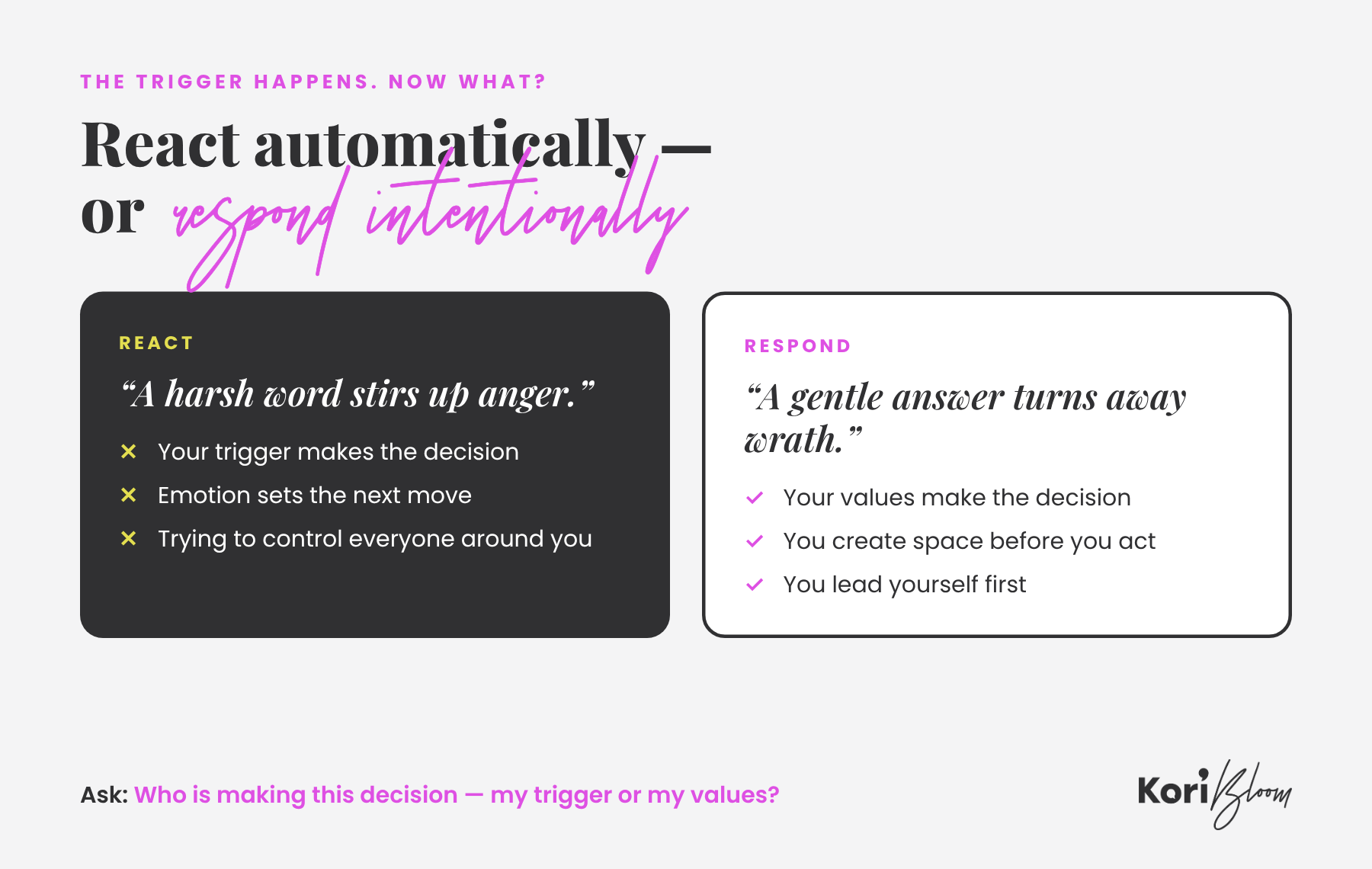
Leadership question: Who is making this decision, my trigger or my values?
6. Growth & Resilience 🌱
This might be the thread closest to my heart. Better, Not Perfect.
I have spent a lot of my life believing that I needed to get things right.
But growth doesn't work that way. Neither does faith.
Philippians 3:12 says:
"Not that I have already obtained all this, or have already arrived at my goal, but I press on…"
Paul wasn't claiming perfection. He was committed to continuing.
Joshua 1:9 reminds us:
"Be strong and courageous. Do not be afraid; do not be discouraged, for the Lord your God will be with you wherever you go."
Faith doesn't mean knowing exactly what will happen next. Faith means taking today's step while trusting that God is already present in tomorrow.
Start before you're ready. Try. Learn. Grow.
Failure is feedback. It is a lesson, not a landing place.
God does not ask us to have everything figured out before we move. We keep pressing forward.
Leadership question: Who am I becoming?
The Biblical Flow of Whole-Person Leadership
The more I looked at these six threads, the more I could see a progression:
- ❤️ Heart = Values & Alignment — What guides me?
- 🧠 Mind = Mindset — How do I choose to think?
- 👀 Eyes = Attention — What am I focused on?
- 🗣️ Mouth = Communication — How do I speak and listen?
- 👣 Hands & Feet = Action — How do I respond?
- 🌱 Character = Growth & Resilience — Who am I becoming?
And then I saw the entire journey:
Your heart influences your mind.
Your mind shapes your attention.
Your attention influences your communication.
Your communication affects your actions.
And your actions, repeated over time, shape your character.
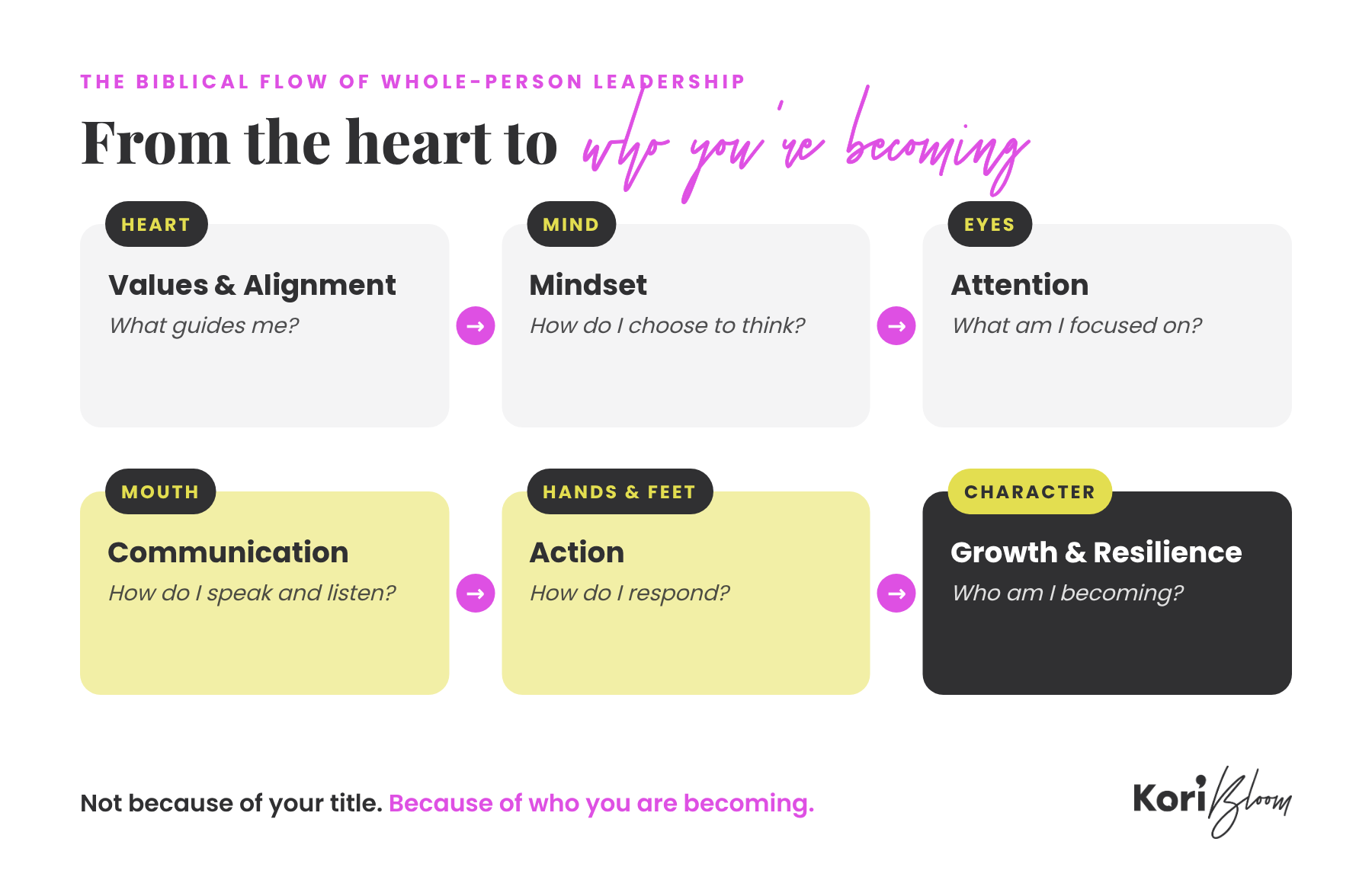
Ultimately, they shape who you are becoming as a leader.
Not because of your title. Not because of your position. Not because someone gave you authority.
But because of who you are becoming.
Lead Yourself First: Where Faith and Leadership Meet
Maybe that is what I love most about this realization.
Whole-Person Leadership isn't about becoming someone completely different. It is about becoming more aligned with who God created you to be.
Guard your heart.
Renew your mind.
Direct your attention.
Communicate with wisdom.
Act with intention.
Keep growing.
And trust God with the journey.
The more I study Scripture, the more I realize the message I have been teaching for years points back to something much bigger than leadership.
It is discipleship. It is becoming. It is learning to faithfully steward the person God created us to be.
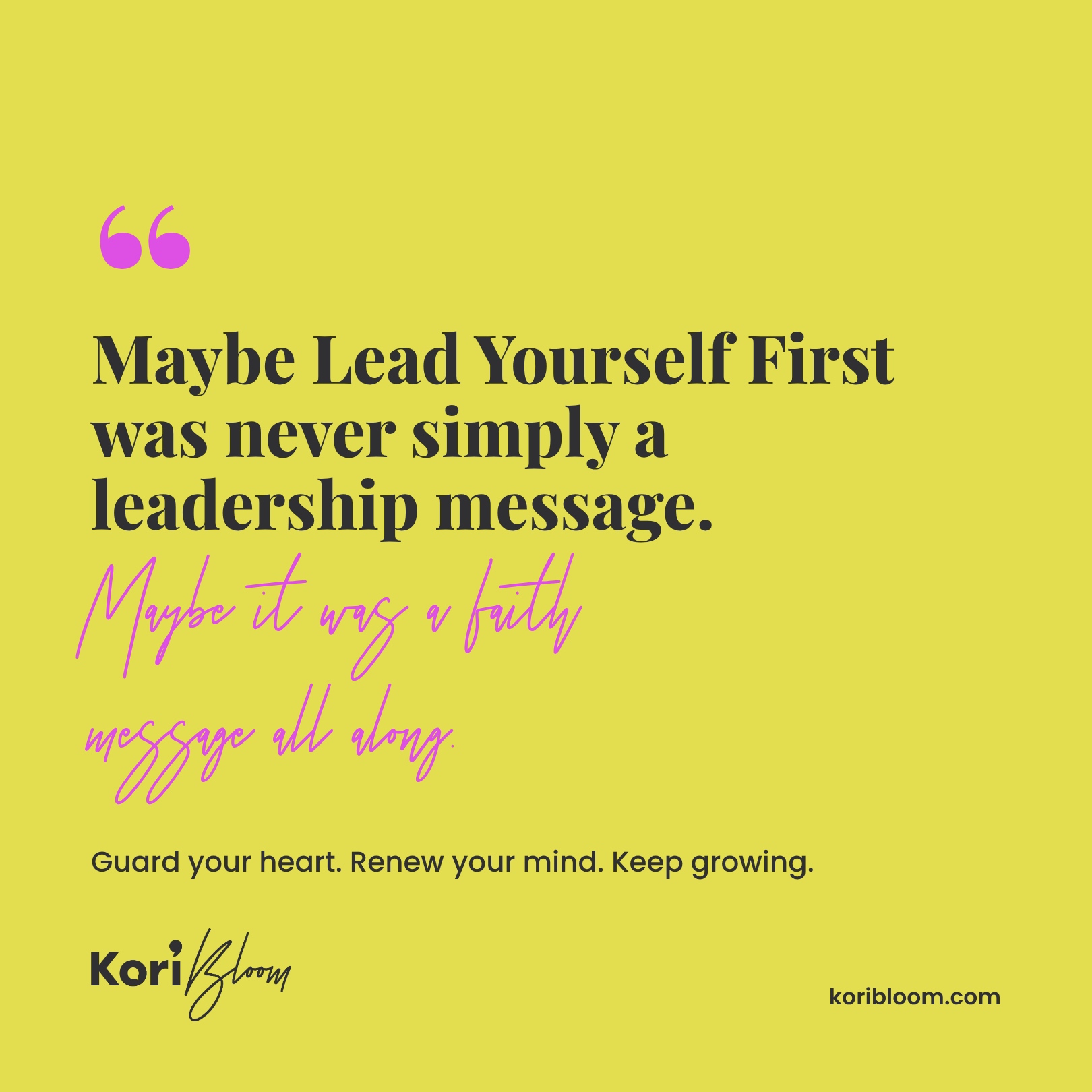
And maybe Lead Yourself First™ was never simply a leadership message.
Maybe it was a faith message all along.
Your Next Step
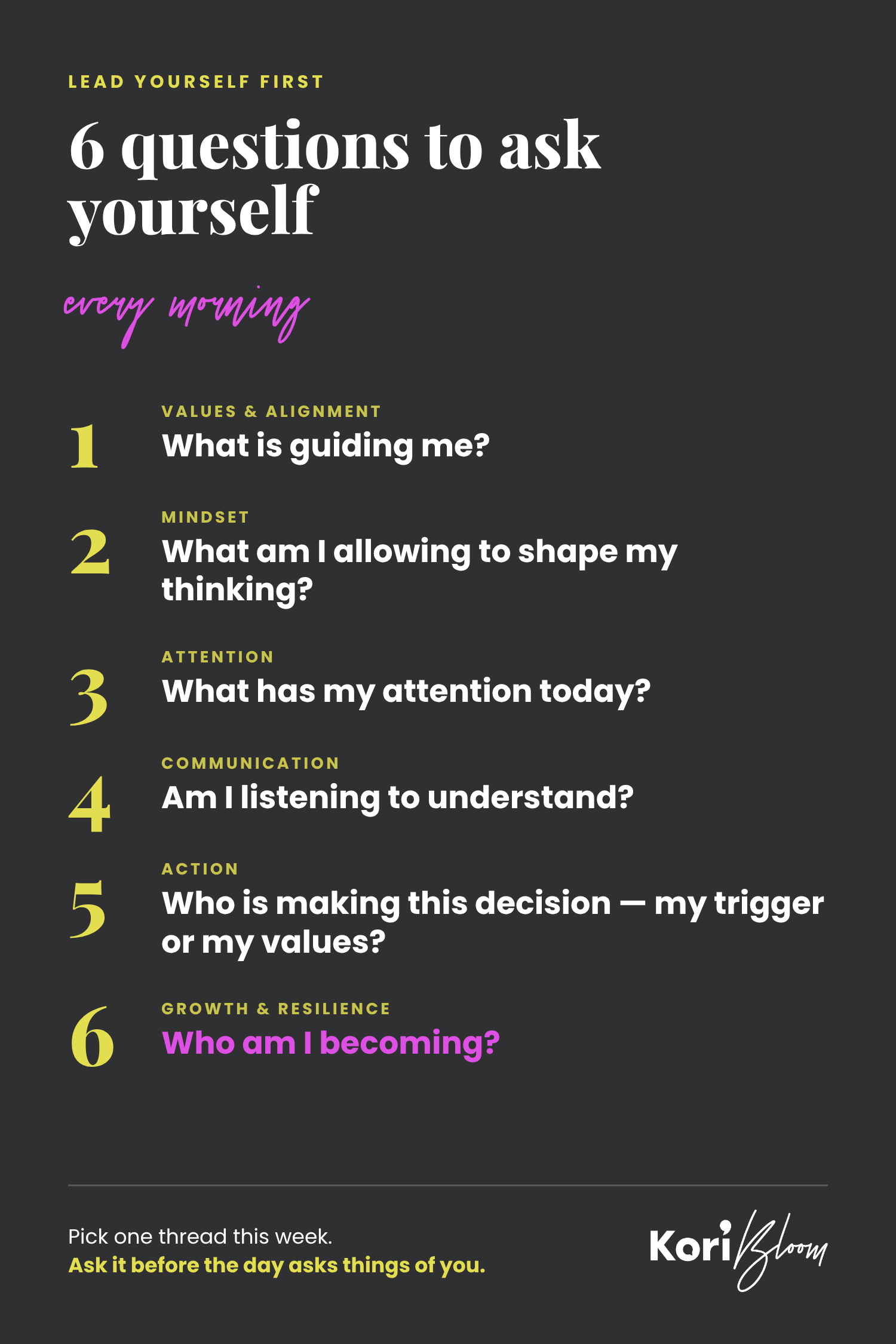
Pick one thread this week. Just one. Write its leadership question somewhere you'll see it — your mirror, your planner, your phone's lock screen — and ask it every morning before the day starts asking things of you.
If you lead a team, a school, or a faith community and want these threads brought into the room, learn more about Kori's keynotes and workshops. And if you want practical words for your next high-pressure moment, grab The Drama-Free Leader: 6 Scripts to Replace Reactive Communication.
Frequently Asked Questions
What are biblical leadership principles?
Biblical leadership principles are truths from Scripture that guide how we lead ourselves and others — guarding our hearts, renewing our minds, listening before we speak, answering gently, and pressing on even when we're not perfect. They focus on character and who you are becoming, not on title or authority.
What are the six threads of Whole-Person Leadership?
The six threads are Values & Alignment, Mindset, Attention, Communication, Action, and Growth & Resilience. Together they map a journey from the heart to the mind, eyes, mouth, hands and feet, and finally to character.
Which Bible verses connect to leadership and self-leadership?
A few that anchor each thread: Proverbs 4:23 and Galatians 1:10 (values and alignment), Philippians 4:8 and Romans 8:6 (mindset), Colossians 3:2 (attention), James 1:19 (communication), Proverbs 15:1 (action), and Philippians 3:12 and Joshua 1:9 (growth and resilience).
Can these principles be used at work and at home?
Yes. That's the heart of Whole-Person Leadership. The same habits that help you respond instead of react with a teenager help you lead a team meeting, a classroom, or a hard conversation with a coworker. You don't become a different person when you walk into a different room.
What does "Lead Yourself First" mean?
Lead Yourself First means your greatest strength as a leader isn't controlling everyone around you — it's leading yourself. When you pause long enough to let your values, rather than your emotions, decide what happens next, the people around you feel the difference.